Home › Guides › Manual vs automatic espresso machine
Manual vs automatic espresso machine: which should you buy?
The real choice is how many steps you want to do yourself. Manual machines give you control, automatic machines give you consistency, and the models in between mix the two.
By Daniel Russo. Updated .
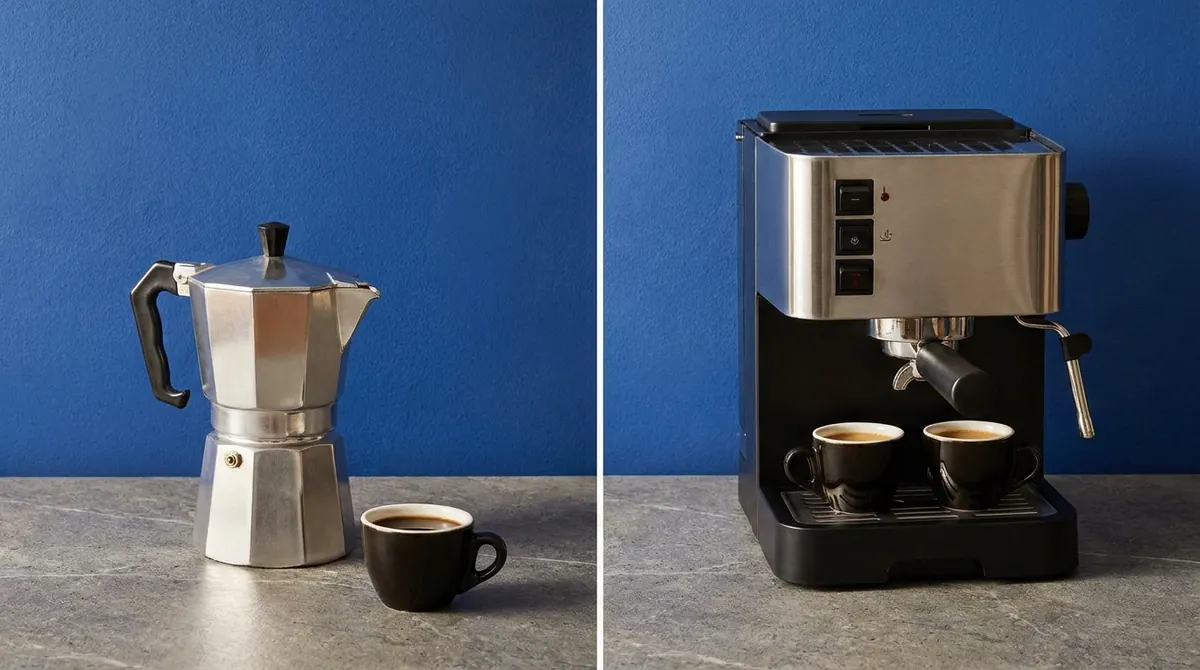
Choose a manual or semi-automatic machine if you want to learn espresso and control grind, dose, tamp and shot. Choose an automatic or super-automatic machine if you want a consistent drink with little effort. Neither makes better espresso on its own: a skilled person can beat an automatic, while a bean-to-cup machine gives a reliable cup with almost no skill. A guided hybrid sits in the middle.
The four types at a glance
| Type | You do | The machine does | Best for |
|---|---|---|---|
| Manual lever | Everything, including the pressure with your arm | Holds the water and the group | Enthusiasts who want direct control |
| Semi-automatic | Grind, dose, tamp, start and stop the shot, steam milk | Heats water and pumps it | Learners and hobbyists |
| Automatic (volumetric) | Grind, dose, tamp and start the shot, steam milk | Stops the shot at a set volume | Repeatable shots without watching |
| Super-automatic | Fill the hopper and tank, choose a drink | Grinds, doses, tamps, brews and often froths | Convenience and households |
Words like manual and automatic are used loosely by retailers. Look at which steps the machine does and which are left to you.
Manual espresso machines
Manual machines use a lever or piston. The first lever-driven machines were developed in Italy in 1945, and that is why we still talk about pulling a shot. With a manual piston, you push water through the grounds directly. Spring piston designs let you cock a spring that delivers the pressure, typically about 8 to 10 bar.
The attraction is complete control over pressure and flow, often with no electronics and a small footprint. The costs are skill, time and effort: you grind, dose, tamp, preheat and press every time. Our manual espresso machine guide and lever guide list options, and our Flair review covers the best-known hand-lever brand.
Semi-automatic machines
A semi-automatic uses an electric pump for pressure, so you no longer supply the force. You still grind, dose, tamp, lock the portafilter in and decide when the shot starts and stops, and you steam milk with a wand. This is the most popular style among home hobbyists, and it is the main category in our semi-automatic guide.
Because grinding and dosing remain your job, the grinder matters as much as the machine. A machine with a built-in grinder lowers the cost and the learning curve, as in our built-in grinder guide.
Automatic (volumetric) machines
An automatic or volumetric machine adds a flow meter, so you can program a shot to stop at a set volume. You still grind, dose, tamp and steam milk, but you can start a shot and move on to another task, and the shot stops by itself. That repeatability helps when you make drinks in a row or share the machine, and it is common in cafes. Some home semi-automatics offer programmable shot volume as well, such as the Breville Dual Boiler.
Super-automatic machines
A super-automatic machine does the whole process. It grinds beans, doses and tamps, brews and, on many models, froths milk. It is a machine that automates the entire process, so a shot is produced with a single touch. The trade-off is less control, a higher price for the automation and internal parts that require care. See our super-automatic guide, the under $1,000 guide and our Magnifica Evo review.
The hybrid middle: guided semi-automatics
Some machines sit between the groups. A built-in grinder, a guided dosing system and automated tamping reduce the hard parts, while you still control the shot and the steam wand. Examples include the De'Longhi La Specialista models and the Breville Barista Express Impress. They suit buyers who want the learning without every difficult step.
Compare the types with real machines
| Machine | Price band | Heating | Grinder | Milk | Price |
|---|---|---|---|---|---|
| Flair 58 | $500 to $650 | Electric preheat for the brew head | Not listed | None | Check price |
| Gaggia Classic Evo Pro | $450 to $550 | Single aluminum boiler | None | Commercial-style steam wand | Check price |
| De'Longhi La Specialista Arte | $500 to $700 | Thermoblock | Built-in conical burr, 8 settings | Manual steam wand | Check price |
| De'Longhi Magnifica Evo | $700 to $1,000 | Not listed | Built-in conical burr, 13 settings | LatteCrema automatic carafe (on LatteCrema version) | Check price |
Control vs convenience
| Manual and semi-automatic | Automatic and super-automatic | |
|---|---|---|
| Control | Full control of grind, dose, tamp and yield | The machine sets most steps |
| Learning curve | Real, but the skill transfers | Minimal |
| Consistency | Depends on your technique | High from the first cup |
| Price for capability | More capability per dollar | A premium for the automation |
| Upkeep | More user steps, simpler parts | Internal complexity to service |
| Milk | Steam wand and practice | Often automatic |
| Speed | A few minutes per drink | One touch |
Which makes better espresso?
Neither, by default. A skilled person with a good grinder and a manual or semi-automatic machine can make better espresso than most automatics, because they can adjust to each coffee. An automatic machine gives a reliably good cup with almost no skill. The skill ceiling is higher on manual machines, and the floor is higher on automatic ones. A good shot has a few simple markers: about 25 to 30 ml in about 25 to 30 seconds, at pressure of about 9 bar.
Learning curve and time
| Machine | First week | After a month |
|---|---|---|
| Manual lever | Slow, messy, inconsistent shots | Repeatable shots with practice |
| Semi-automatic | Mixed results while you dial in | Reliable shots and basic milk texture |
| Hybrid | Good results quickly | Fine-tuning grind and temperature |
| Super-automatic | Good results at once | Little changes; adjust beans and settings |
If you want to get started with the least difficulty, see our guide to espresso machines for beginners. If you want to learn technique, start with how to make espresso at home.
A shot on each type of machine
| Step | Manual lever | Semi-automatic | Super-automatic |
|---|---|---|---|
| Water | Heat in a kettle or the machine, then add | Fill the tank and let the machine heat | Fill the tank |
| Grind | With a separate grinder | With a separate or built-in grinder | Automatic |
| Dose and tamp | By hand | By hand, or guided on hybrids | Automatic |
| Pressure | You press the lever | The pump supplies it | The pump supplies it |
| Stop the shot | You decide | You decide, or a timer or volume setting | Automatic |
| Milk | A separate frother or wand | Steam wand | Carafe or wand |
| Clean-up | Rinse the parts | Rinse, wipe and flush | Empty bins and run cycles |
What you will spend beyond the machine
| Extra | Manual and semi-automatic | Super-automatic |
|---|---|---|
| Grinder | Needed unless the machine has one | Built in |
| Scale | Strongly advised | Not needed |
| Tamper and pitcher | Needed | Not needed on most |
| Kettle | Needed for hand levers | Not needed |
| Cleaning supplies and descaler | Needed | Needed |
| Water filter | Helpful | Often recommended |
Fresh, good beans matter on every type. See our espresso bean guide and the espresso grinder guide.
Home use and commercial use
This choice looks different in a cafe. For commercial buyers, the question is how much of the process depends on staff skill and how easily the same drink can be repeated across people and shifts. A manual or semi-automatic machine gives trained baristas control, while an automatic or super-automatic machine helps when many staff members share a machine, or when speed and repeatability matter most. Commercial buyers also compare drink volume, group heads, steam capacity and service access. See our commercial machine guide.
Common mistakes when choosing
- Choosing by name alone. Manual, semi-automatic and automatic are used loosely, so read what the machine does.
- Ignoring the grinder. A good machine with a weak grinder will disappoint.
- Buying more control than you will use. A complicated machine you never learn is wasted.
- Buying more automation than you need. You may miss the control later.
- Forgetting upkeep. Every machine needs cleaning and descaling.
- Not checking counter space. Measure width, height and the room to lift the tank.
The upgrade path
You can start simple and move up. A beginner might start with a compact semi-automatic, add a good grinder, and later move to a dual boiler or a machine with programmable pre-infusion. Someone who starts with a super-automatic can move to a semi-automatic later if they want more control. If you think you will want to learn, a guided hybrid gives a smoother path, and our dual boiler guide shows where a hobbyist may end up.
What to look for in each type
| Type | Look for |
|---|---|
| Manual lever | A pressure gauge, a stable frame, a basket size that fits your dose, and easy preheating |
| Semi-automatic | A 58 mm portafilter if you want accessories, stable temperature control, a good steam wand and a capable grinder |
| Automatic (volumetric) | Programmable shot volumes that you can save for single and double shots |
| Super-automatic | A grinder with enough settings, a milk system that cleans easily, a removable brew unit and a clear display |
| Hybrid | A grinder you can adjust, dose control or guidance, and a steam wand you like |
Everyday scenarios
| Situation | Suggested type |
|---|---|
| Busy weekday mornings, one drink | Super-automatic or a capsule machine |
| Weekend project and a love of coffee | Semi-automatic or manual lever |
| A household with different tastes | Super-automatic with saved drinks |
| A small kitchen | Compact semi-automatic or hand lever |
| Entertaining guests with milk drinks | Dual boiler or a bean-to-cup machine with automatic milk |
| Travel or camping | A portable manual maker, see our portable guide |
Taste and crema
Crema forms on espresso from fine, fresh grounds and high pressure, so it appears on every type of machine when the shot is right. Taste differences usually come from the beans, the grind and the water, not from the label on the machine. A bean-to-cup machine can produce a fine cup when it is set up well, and a manual machine can produce a poor one if the grind is off. Spend time on beans, water and cleaning, and you will get more improvement than from switching machine types.
Cleaning and maintenance
Manual and semi-automatic machines have more user steps, such as rinsing the portafilter, wiping the wand and, on some, backflushing. Super-automatics have rinse cycles and cleaning programs, but they have more internal parts that need regular care, including the brew unit, the milk system and descaling. Either way, regular cleaning matters. See how to clean an espresso machine and how to descale one.
Who should buy which
| If you | Buy |
|---|---|
| Love tuning shots and learning the craft | Manual or semi-automatic |
| Want a hand-pulled, no-electronics routine | Manual lever |
| Want repeatable shots without watching the timer | Automatic (volumetric) or a programmable semi-automatic |
| Want one button and no technique | Super-automatic |
| Want to learn, but not every difficult step | Guided hybrid |
| Share the machine with non-enthusiasts | Super-automatic or hybrid |
| Have a limited budget and want capability | Semi-automatic plus a grinder |
A simple test to decide
Think about your mornings. Count how many minutes you are willing to spend weighing, grinding, tamping and pulling, and whether you would enjoy the ritual or resent it. If you enjoy it, a manual or semi-automatic machine will reward you. If you want the drink and nothing else, an automatic machine will make you happier. Most people find the answer has more to do with temperament than skill.
Related comparisons
See also semi-automatic vs automatic, espresso machine vs Keurig, espresso machine vs Nespresso and moka pot vs espresso machine.
Questions people ask
What is the difference between manual and automatic espresso machines?
On a manual or semi-automatic machine you grind, dose, tamp and control the shot yourself. On an automatic or super-automatic machine, the machine does some or all of those steps.
Are automatic espresso machines worth it?
Yes, when convenience and consistency matter most and you are willing to pay for the automation. If you want craft and control, a manual machine gives more capability for the money.
Do automatic machines make better espresso?
Not automatically. A skilled person can beat them, but an automatic gives a good cup with almost no skill.
What is a semi-automatic espresso machine?
It uses an electric pump for pressure, and you control the grind, dose, tamp and the start and stop of the shot.
What is a super-automatic espresso machine?
It grinds beans, doses, tamps and brews at a button press, and often froths milk too.
Which is easier to clean, manual or automatic?
Manual machines have simpler parts but more user steps. Automatic machines have cleaning cycles but more internal parts to maintain.
Is a manual machine cheaper?
Often it is cheaper for the capability, but you need a grinder, which adds cost.
Which is best for beginners?
A bean-to-cup machine or a guided hybrid gets good results fastest. A semi-automatic is best if you want to learn.
Can I use pre-ground coffee in an automatic machine?
Some do. The Magnifica Evo, for example, has a small flap for pre-ground coffee, but check your manual. A fresh grind from the machine usually tastes better.
Which machine is best if I only make milk drinks?
A super-automatic with an automatic milk system is the easiest. A semi-automatic with a steam wand gives you more control over foam if you are willing to practice.
Is a hybrid machine a good compromise?
Yes for many buyers. A guided hybrid automates grinding and tamping but leaves the shot and the steam wand to you.
Do I need to buy a grinder for a manual machine?
Yes, you need a good espresso grinder with fine adjustment, unless the machine has one built in. A hand grinder works with hand-lever machines.
Is it hard to switch from automatic to manual?
It takes patience. You will need to learn grind, dose and tamp, but the skills are easy to practice, and many people find it satisfying within a few weeks.
Can an automatic machine make cafe-style drinks?
Yes. Many models make lattes, cappuccinos and flat whites at a touch, with milk handled by a carafe or a wand.
Sources
Read next
- Semi vs automaticHow much of the work do you want to do?
- Best manualLever and hand-powered espresso makers.
- Best semi-automaticMachines that give you control over every shot.
- Best super-automaticBean-to-cup machines that make drinks at the push of a button.
- Best for beginnersForgiving machines that make good espresso from week one.
- Breville vs De'LonghiWhich brand fits the way you make coffee?