Home › Guides › Clean an espresso machine
How to clean an espresso machine
Coffee oils, milk residue and mineral scale build up quickly. A short routine, repeated on a schedule, keeps espresso tasting clean and the machine running for years.
By Daniel Russo. Updated .
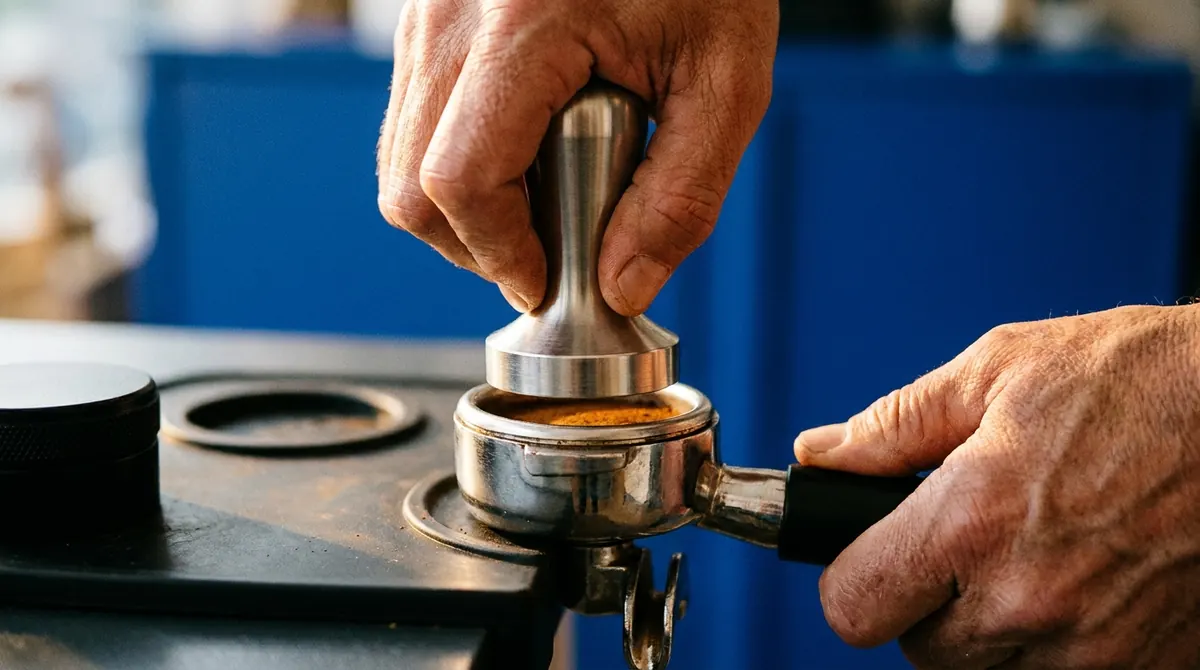
After every shot, knock out the puck, rinse the portafilter and flush the group. After every milk drink, purge and wipe the steam wand. Weekly, wash the drip tray, tank and portafilter, and backflush only if your manual says your machine can be backflushed. Every month, deep clean with a coffee-machine cleaner, and descale on the schedule in your manual.
Check your manual first
Espresso machines differ more than they look. Cleaning products, intervals and procedures vary by maker, and some brands void the warranty if you use another descaler. The steps below describe general good practice for most home machines. If the manual says something different, follow the manual.
After every shot
- Knock out the puck while it is warm. Cooled grounds set and are harder to remove, and oils seep into the shower screen.
- Rinse the portafilter and basket under the tap and dry them with a clean cloth.
- Flush the group head with a short blank shot to wash out stray grounds and oils.
- Wipe the group head area with a brush or cloth to remove grounds from around the gasket and shower screen.
After every milk drink
Milk dries fast and clogs the steam tip. Wipe the wand immediately while it is hot, then purge a short burst of steam so milk inside the tip is blown out. Rinse the pitcher straight away. For an automatic milk system, run the rinse or cleaning cycle your machine offers after each use, as the manual describes.
Weekly routine
| Task | How |
|---|---|
| Drip tray and grate | Remove, wash with warm soapy water and dry |
| Water tank | Empty, rinse and refill with fresh water |
| Portafilter and baskets | Rinse well and wipe dry |
| Exterior | Wipe the machine and the area under the portafilter |
| Grounds bin | Empty it on a super-automatic |
| Backflush | Only if your manual says your machine supports it |
Backflushing: only on some machines
Backflushing means running water, or water with a cleaning powder, back through the group head using a blind basket with no holes. Only machines with a 3-way solenoid valve can be backflushed. That valve relieves pressure after a shot, and without it the water has nowhere to go when the basket is blocked, so you could damage the machine.
- Can be backflushed: most machines with a commercial-size group and a 3-way valve, and many mid-range semi-automatics. Check the manual.
- Generally cannot: many entry-level machines, manual levers and super-automatics, which have their own cleaning cycles.
- A quick test: if your machine came with a blind basket, it was designed for backflushing.
A common routine is a water-only backflush every week and a detergent backflush each month: insert the blind basket, run the pump for 10 seconds, pause for 10 seconds and repeat five times. After using detergent, rinse with several water-only cycles and discard the first shot. Never use a descaling solution or vinegar to backflush.
Monthly deep clean
- Detergent clean. Use a cleaner made for espresso machines, such as the cleaning tablets in our guide, and follow the pack. Rinse thoroughly afterward.
- Soak the parts. Soak the portafilter and baskets for 15 to 20 minutes in a cleaning solution, then rinse. If you can remove the shower screen, soak it too.
- Clean the steam wand tip. Many tips unscrew. Use a cleaner formulated for milk, since coffee cleaners are for coffee oils.
- Check the gasket. Look for cracks or hardening and replace the group gasket when it looks worn.
Descaling
Descaling removes mineral deposits from the boiler and water lines, which backflushing does not. Use the descaler your manual recommends and follow its steps. Run the solution through the brew outlet, hot water outlet and steam wand in turn, then rinse with several tanks of clean water. Remove the water filter first if the manual says so. Descale more often in hard-water areas, or when flow slows and shots take longer. See our guides to descaling an espresso machine, descaling a Breville and descaling a De'Longhi.
Cleaning the grinder
If your machine has a built-in grinder, coffee oils collect on the burrs and in the chute, which can make the grinder jam or stale the flavor. Empty the hopper, run the grinder until it is empty and use a soft brush on the burrs and chute, following the manual. Dedicated grinder cleaning pellets are an option for some models. Oily dark roasts and flavored beans leave more residue, so clean more often if you use them.
Super-automatic machines
A bean-to-cup machine does much of the work itself, with rinse cycles at start-up and shut-down and a cleaning program for the milk system. Your job is to empty the grounds bin and drip tray, wash the tank, clean the milk carafe, run the cleaning program when the machine asks and remove and rinse the brew unit if the manual says it is removable. Do not backflush it. See our super-automatic guide for models that are easy to maintain.
Water, filters and scale
Water quality decides how fast scale forms. Using filtered or softened water helps, and many machines accept a filter cartridge in the tank that you replace on a schedule. Test your water hardness if you can, since harder water means more frequent descaling. Never leave water standing in the tank for days, and refill with fresh water before use.
Brand-specific guides
If you own one of these, see the steps for your model: how to clean a Breville and how to clean a De'Longhi.
A simple schedule
| When | Task |
|---|---|
| Every shot | Knock out the puck, rinse the portafilter, flush the group |
| Every milk drink | Wipe the wand, purge steam and rinse the pitcher |
| Weekly | Wash trays and tank, wipe the exterior and, if supported, a water backflush |
| Monthly | Detergent clean, soak the baskets and portafilter, deep clean the wand tip |
| Every 3 to 6 months | Descale, subject to your manual, and check the gasket |
| Yearly | Replace the gasket and shower screen, or have the machine serviced |
Signs the machine needs cleaning
- Coffee tastes bitter or stale even with fresh beans.
- Dark, oily buildup on the group head or shower screen.
- Shots run slower or more unevenly than before.
- Weak steam or a slow flow of hot water, which points to scale.
If you are behind, do not try to fix everything in one day. Clean this week, descale the next, and replace worn parts after that.
What not to do
- Do not backflush a machine without a 3-way valve.
- Do not put the machine or its electronics in water.
- Do not use dish soap in the group or the boiler lines.
- Do not use a descaler your manual does not approve.
- Do not leave milk on the wand or water standing in the tank.
Questions people ask
How often should I clean my espresso machine?
Rinse after every shot, wipe the steam wand after every milk drink, wash trays and the tank weekly, and deep clean monthly.
How do I clean an espresso machine with vinegar?
Some makers allow it, others do not. If the manual permits, mix equal parts water and vinegar, run it through, then rinse well. A purpose-made descaler is usually safer.
What is backflushing?
It is running water or detergent back through the group head with a blind basket. It only works on machines with a 3-way solenoid valve.
How do I know if my machine has a 3-way valve?
Listen for a short hiss and see a little water drain into the tray after a shot, or check whether a blind basket came with the machine.
How often should I descale?
It depends on your water and the machine. Many guides suggest every few months, more often with hard water. Follow the manual.
Can I put parts in the dishwasher?
Only if the manual says so. Drip trays are often dishwasher safe, but portafilters and metal parts may not be.
Do I need to clean a machine I only use on weekends?
Yes. Rinse and wipe it after each use, and empty the water tank between sessions. Oils and milk residue go stale whether or not you use the machine daily.
Can I clean the shower screen myself?
On many machines you can unscrew it, soak it in a cleaning solution and brush it. If your manual does not describe removing it, leave it in place and use a brush.
Sources
Read next
- Descale an espresso machineHow often, with what, and the steps for each machine type.
- Cleaning tabletsTablets and descalers that keep machines healthy.
- Clean a BrevilleDaily, weekly and monthly cleaning steps.
- Clean a De'LonghiCleaning and descaling for pump and super-automatic models.
- Use an espresso machineThe universal workflow for any machine.
- Espresso machine vs NespressoReal espresso or pods: cost, taste and effort compared.