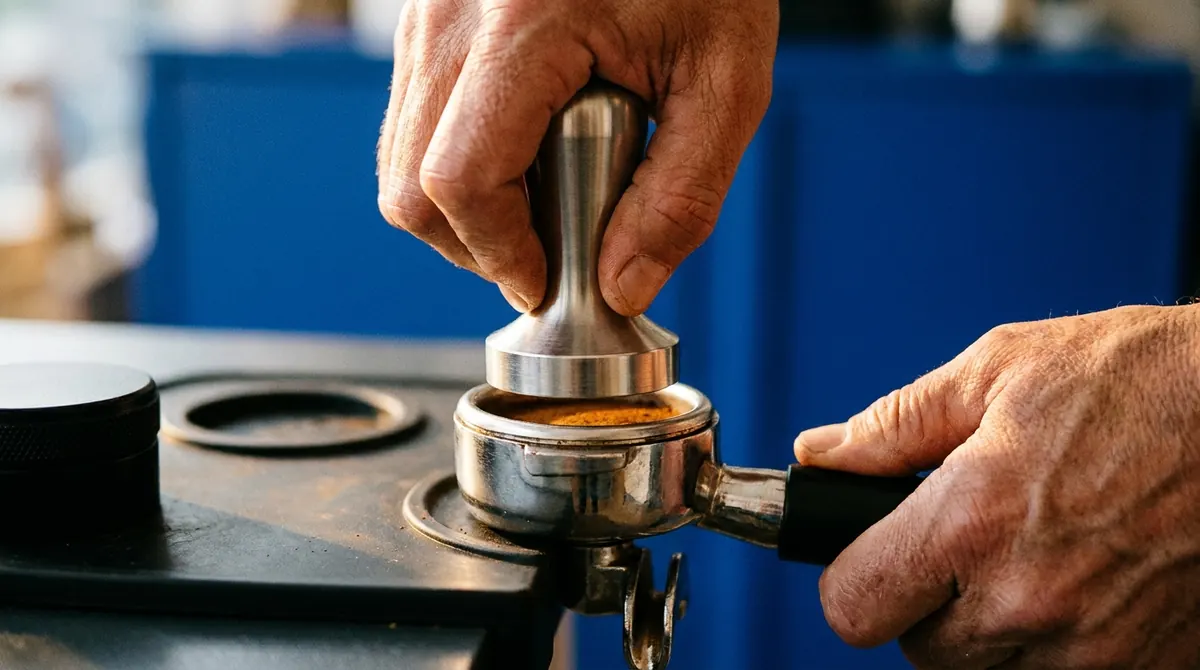
Tamping packs the grounds into an even puck so water flows through all of it at the same speed. Even matters more than hard.
By Daniel Russo. Updated .
The short answer
Dose 7 to 10 grams for a single or 18 to 22 grams for a double, level the grounds, hold the tamper level above the basket and press straight down with steady, firm pressure of roughly 20 to 30 pounds, then give one quick twist as you lift off. Check that no grounds are left on the rim. If you use a calibrated or spring-loaded tamper, you will get the same pressure every time.
Why tamping matters
Espresso is made by pushing hot water through a bed of finely ground coffee at high pressure. Water takes the easiest path. If the bed is loose, uneven or has a gap, water rushes through that spot and leaves the rest under-extracted. That is called channeling, and it makes shots that taste sour and bitter at the same time.
A good tamp makes the bed dense and level so resistance is the same everywhere. It does not fix a bad grind, but a bad tamp can ruin a good one.
Before you tamp: grind and dose
Fresh beans. Store them airtight, in a cool, dry place out of direct sun.
Grind slightly finer than table salt, ideally with a burr grinder. Too coarse and water rushes through. Too fine and the shot chokes. The right setting depends on the roast and the beans.
Weigh the dose. Aim for 7 to 10 grams for a single shot and 18 to 22 grams for a double. A scale is the only way to repeat it.
Level the bed. Tap the sides of the portafilter against the counter to settle the grounds. A distribution tool, such as a WDT tool with fine needles, breaks up hidden clumps.
Step by step
Set the portafilter on a flat, stable surface, such as a tamping mat or the counter edge.
Grip the tamper. The classic grip is thumb, forefinger and middle finger around the handle, like holding a doorknob. Wrapping your fingers around the handle with the thumb on top gives more force if you need it.
Align it. The tamper should fit the basket (common sizes are 54 mm and 58 mm) and sit level, parallel to the counter.
Stack your joints. Keep your elbow bent and directly above your wrist, with a straight wrist and forearm. Use your body weight rather than your wrist muscles to be consistent.
Press straight down with steady pressure of about 20 to 30 pounds. Focus the force in the center. Do not lean to one side.
Finish gently. Release a little pressure, give a single quick twist to polish the surface and free the tamper, and lift it off cleanly.
Clean the rim. Brush any grounds off the edge of the basket and the rim so the portafilter seals properly in the group.
After the shot, check the spent puck. It should be smooth and level and come out as one piece. A cracked, wet or crumbled puck points to uneven tamping or a poor grind.
How hard to tamp
The usual advice is about 20 to 30 pounds of force. Consistency matters more than the exact number. You can practice on a kitchen scale until your arm learns the feel. In practice there is rarely harm in pressing harder than 30 pounds; what matters is that the bed is level and the pressure is the same every time. New baristas more often tamp too lightly, which leaves a loose puck and under-extracted shots.
Choosing a tamper
The most important rule is that it must fit your basket. Measure the inner diameter of the basket and buy a matching size.
Style
What it is
Good for
Flat base
The traditional shape, pressing evenly across the whole surface
Most people; simplest and most predictable
Convex base
Slightly rounded to compress the edges and discourage side-channeling
Experienced users willing to experiment; can cause uneven density
Palm (puck) tamper
Compact handle that sits in your palm for stability
Smaller hands and steadier presses
Dual head
Two sizes or two shapes on one handle
People with a single and a double basket
Calibrated or spring-loaded
Delivers a set force, generally 20 to 30 pounds
Beginners and anyone who wants the same pressure each shot
Machines vary in basket diameter. In the machines listed on this site, the Breville Bambino, Barista Express and Barista Pro use 54 mm, the De'Longhi Stilosa and Dedica use 51 mm, and the Gaggia Classic, Rancilio Silvia, Breville Dual Boiler and Oracle Jet use 58 mm. Many machines include a tamper, but a better one is a cheap upgrade.
Best spring-loaded tamper
Normcore Spring-Loaded Tamper
Under $50Accessory
Gives the same pressure every shot, and it comes in several sizes to match 51, 53.3 and 58.5 mm baskets and more.
About 20 to 30 pounds of pressure, applied evenly. Consistency matters more than the number. There is rarely harm in pressing harder than that, as long as the bed is level.
Do I need a tamper if my machine comes with one?
A bundled tamper works, but many are lightweight or loose-fitting. A properly sized, well-made tamper is an inexpensive upgrade that makes it easier to press level.
What size tamper do I need?
Match the inner diameter of your basket. Common machine sizes are 51 mm, 54 mm and 58 mm.
Should I twist the tamper?
One quick twist as you finish and lift can polish the surface and free the tamper. Do not rotate during the press, which can tilt the grounds.
Do I need a leveler or distribution tool?
Not at first. Tapping the portafilter and leveling with a finger is enough while you learn. A WDT tool, a small tool with fine needles, helps break up clumps once you want to improve consistency.
Is tamping the same on every machine?
The technique is the same. The tamper size, basket depth and grinder differ. Machines with pressurized baskets are more forgiving of tamping errors.