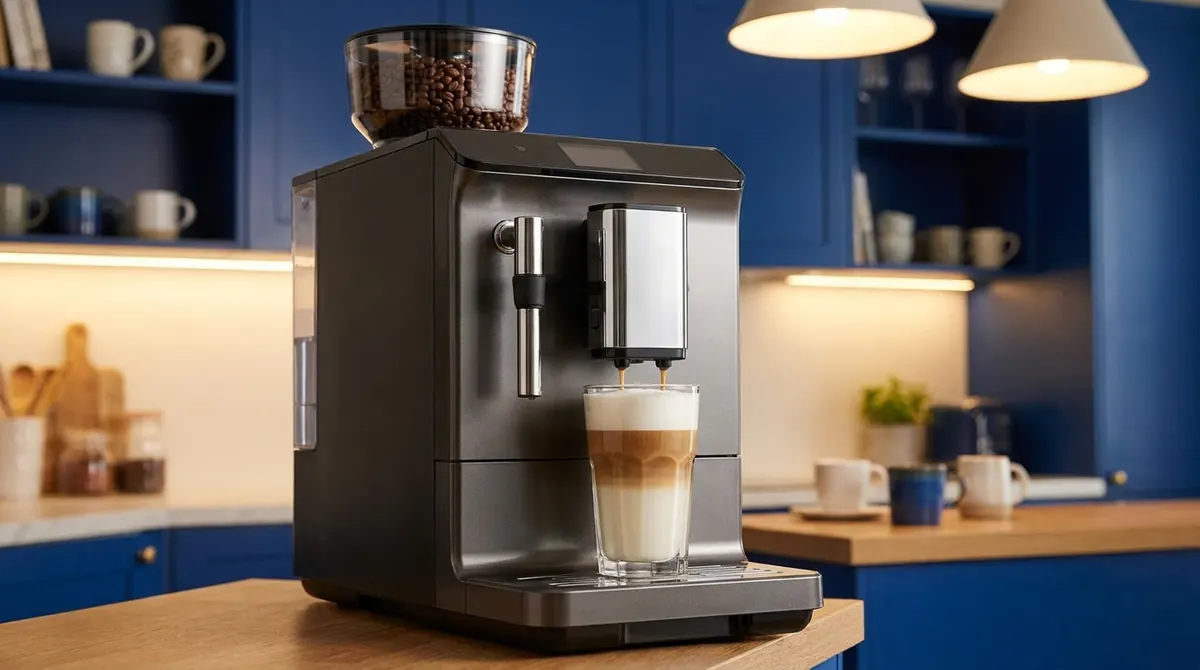
De'Longhi La Specialista review: which model is worth buying
La Specialista is De'Longhi's line of manual bean-to-cup espresso machines: a grinder, a portafilter and a real steam wand in one body. The models share a design but differ in tamping, milk and drink menus.
By Daniel Russo. Updated .
The short answer
For most buyers the De'Longhi La Specialista Arte Evo is the one to buy: a compact 51 mm semi-automatic with a built-in grinder, a pressure gauge, a real steam wand and a cold brew function. Pay more for the Opera if you want automated tamping and sensor grinding, and for the Maestro if you want automatic milk frothing as well. The grinder has only 8 settings and the dose is timed, so a scale helps. Our rating: 8.5 out of 10 for the Arte Evo.
The verdict
Best La Specialista for most people
De'Longhi La Specialista Arte Evo
Under $700Semi-automatic
It keeps the grinder, thermoblock heating, pressure gauge and steam wand of the Arte and adds a cold brew function, in a body that is among the most compact of any manual bean-to-cup machine. It is simple to set up and rewards a little practice.
Portafilter
51mm, two single-wall baskets
Heating
Thermoblock with active temperature control
Grinder
Built-in stainless conical burr, 8 settings
Milk
My LatteArt manual steam wand
Tank
1.7 L
Extras
Cold brew, pressure gauge, dosing and tamping guide
Our rating is based on De'Longhi's specifications, the manual and reviewer and owner feedback, plus typical prices. It reflects value, ease of use and results, not lab testing.
The La Specialista lineup
All La Specialista machines are manual: you load the portafilter, lock it in and start the shot. The grinder and tamping help, and the steam wand is a real one. The models climb in automation.
Model
Grinding and tamping
Milk
Drinks
Extras
Arte
Built-in conical grinder, dosing and tamping guide
My LatteArt steam wand
2 preset recipes
Barista toolkit
Arte Evo
Same as Arte
My LatteArt steam wand
Espresso, Americano and cold brew
Cold extraction technology
Opera
Sensor grinding and a smart tamping station
My LatteArt steam wand
5 preset recipes
Cold brew and iced espresso
Maestro
Sensor grinding and a smart tamping station
LatteCrema Hot automatic frothing
8 preset recipes
Up to 5 infusion temperature profiles
Touch
Sensor grinding with a precision tamper
Automatic steam wand with five froth levels
10 preset recipes
Four user profiles
Check each listing for the exact version. De'Longhi changes model names and menus between regions.
Specs: Arte Evo (EC9255M)
Spec
Detail
Type
Manual bean-to-cup semi-automatic
Portafilter
51 mm, with two single-wall baskets (single and double)
Pump
15 bar
Heating
Thermoblock with active temperature control, three temperature settings
The Arte models are called hybrids: they grind for you, but you still dose, tamp and control the shot. The sequence is the same every time.
Slide the portafilter into the grinding station and press the grind button. The timed dose dial sets how long the grinder runs.
Use the dosing funnel and tap the portafilter so grounds settle.
Tamp with the tamper and the tamping mat for even pressure.
Lock the portafilter into the group head and choose single or double shot.
Start the shot and watch the pressure gauge, which has an Optimal Zone marker.
Steam milk with the My LatteArt wand if you want a latte or cappuccino.
The Opera and Maestro replace manual tamping with a smart tamping station and use sensor grinding, so each dose is more repeatable. The Maestro adds automatic milk frothing.
The grinder and dosing
The Arte models have a stainless steel conical burr grinder with eight settings on a dial at the bottom of the hopper. Eight steps is a narrow range for espresso, and you cannot set the dial between two positions, so you have less control than with a stepless or finer-stepped grinder. The dose is timed: a dial controls how long the grinder runs, which means the amount of coffee changes when you change the grind. For repeatable results, weigh the dose with a scale. The manual's suggested dose settings are a starting point, not a final answer. The hopper holds about 250 g, which is modest but means beans do not sit for long. It is not removable, so switching between regular and decaf beans needs care.
What you want
What to do
Stronger or finer shot
Move to a finer setting and check shot time against 25 to 30 seconds
More coffee in the basket
Increase the dose dial, then re-weigh
Consistent doses
Weigh the grounds with a scale
Cold brew
Use a coarser grind, around settings 4 to 6
The portafilter and baskets
The portafilter is 51 mm, smaller than the 58 mm standard on prosumer machines, which limits aftermarket accessories. The machine ships with two single-wall baskets (single and double), not pressurized ones, which is good for learning real espresso technique. Reviewers note the baskets can be tough to pry out of the portafilter and that the portafilter takes some force to lock in, so brace the machine with one hand.
Heating, temperature and pressure
The Arte models use a thermoblock, so they are ready in under a minute. The trade-off is that a thermoblock machine needs a flush: run hot water through the group head and the portafilter a few times so the metal is hot. Three temperature settings let you match the roast. The quick-start guide says robusta beans prefer a lower temperature and arabica a higher one. A pressure gauge on the front shows how the extraction is going, though it marks an Optimal Zone rather than numbers. The 15 bar pump rating is a spec figure. Espresso is conventionally brewed at about 9 bar, so judge the shot by taste and timing.
The My LatteArt steam wand
The steam wand is the strongest feature of the Arte line. It is mounted on a ball joint with a good range of motion, produces enough steam for silky microfoam, and can be swung out so the included metal milk jug fits under it. Reviewers describe making smooth microfoam and basic latte art on the first attempts, guided by the quick-start tips: use cold milk in a cold jug, place the tip just under the surface to stretch the milk, then sink it to heat. Switching from espresso to steam takes a short wait, and a separate hot water spout avoids using the wand for tea. See how to steam milk for the full technique.
Cold brew on the Arte Evo and Opera
Cold Extraction Technology uses low pressure and room-temperature water to make a cold brew in minutes. On the Arte Evo, a single dose of coffee is mixed with about 3.7 fl oz (110 ml) of water, and a double dose makes about 6 fl oz (180 ml). De'Longhi recommends a coarser grind of about four to six. Reviewers found the result smooth, sweet and low in bitterness but a little weak at the middle setting, and moving to a coarser setting made it stronger. The result is a convenience feature, not a replacement for a dedicated cold brew method. If cold brew is a priority, the Opera adds an iced espresso option too. If it is not, the original Arte is the same machine without it.
Where the Arte Evo falls short
Narrow grind range. Eight settings and no half steps limit fine-tuning.
Timed dosing. A scale is needed for consistency.
51 mm portafilter. Fewer accessories than 58 mm machines.
Cold brew is mild. It is a nice extra but not a showpiece.
Machine moves. At about 21.5 lb it can slide when you lock the portafilter in, so hold it steady.
Not a dual boiler. You cannot brew and steam at the same time, though the switch is quick.
Setup and first use
Wash and dry the accessories and the water tank, then fill the tank.
Rinse the included water-softening sachet and drop it in the tank. It is designed to last about three months.
Plug in, turn the machine on and run the short rinse cycle with a bowl under the spout.
Insert a basket in the portafilter, lock it in and rinse it with water.
Flush the steam wand into the bowl.
Set the temperature (the highest level suits most arabica beans), choose the grind setting and dose, and pull your first shot.
Cleaning and care
When
Task
After every shot
Knock out the puck, rinse the portafilter and basket
After every milk drink
Purge and wipe the steam wand
Daily
Empty the drip tray, the tray grille and the grounds bin; rinse the tank
Weekly
Wash the drip tray parts (dishwasher safe), the jug and the tamper
Every three months
Replace the water-softening sachet
As needed
Descale with De'Longhi's descaler, following the manual
The closest Breville rivals are the Barista Express and the Barista Express Impress. The Breville machines have a 54 mm portafilter, more grind settings and, on the Impress, assisted tamping and dose control. The La Specialista Arte Evo is smaller, has a cold brew option and a very capable steam wand, and often costs less. The Opera and Maestro compete with the Impress and Barista Touch on automation. For the brand-level comparison, read Breville vs De'Longhi.
La Specialista Arte Evo
Breville Barista Express Impress
Portafilter
51 mm
54 mm
Grinder
8 settings, timed dose
More settings, dose control
Tamping
Manual with guide
Assisted tamping lever
Steam wand
My LatteArt, manual
Manual
Cold brew
Yes
No
Size
Compact
Larger
Who should buy which model
If you
Buy
Why
Want a compact bean-to-cup semi-automatic with a steam wand
The simplest way to choose is to decide how much of the routine you want the machine to do. Every step you automate removes a chance for variation, but it also removes a skill you might enjoy learning.
Arte or Arte Evo: you grind, dose by time, tamp by hand and steam milk yourself. This is the most hands-on version and the one that teaches the most about espresso.
Opera: grinding is sensor-driven and tamping happens in a smart station, so the puck is more repeatable. The steam wand is still manual, which keeps latte art possible.
Maestro: adds automatic milk frothing (LatteCrema Hot) and a longer menu of preset recipes, plus several infusion temperature profiles. It suits people who want a milk drink at the press of a button but still like the option of a wand.
If you are unsure, start with the lower tier. The shot-making skills you learn on an Arte transfer to any espresso machine, while the extra automation is mostly about convenience and repeatability.
A first week with a La Specialista
A hybrid machine rewards a short, deliberate learning period. Most of the frustration new owners report comes from changing several things at once, so change one variable per shot.
Day one: set up the machine, run the rinse cycle and make a few shots just to learn the workflow. Expect them to be imperfect.
Day two: weigh the dose from the grinder with a scale and write it down. Then fix the dose and change only the grind setting.
Day three: time the shot from the moment the pump starts. Aim for roughly 25 to 30 seconds and adjust the grind one step at a time.
Day four: add milk. Purge the wand first, keep the tip just under the surface for a few seconds to add air, then lower it to swirl the milk.
Day five onward: keep notes on beans, setting and result. Fresh beans change the best setting as they age, so expect to re-adjust.
With only eight settings, you may find that no step lands exactly where you want. In that case adjust the dose dial slightly to fine-tune the result.
Making the main drinks
Drink
How to make it
Notes
Espresso
Grind, dose, tamp and run a shot of about 25 to 30 ml
A typical shot lasts about 25 to 30 seconds
Americano
Pull a shot, then add hot water from the spout
Use the hot water spout rather than the steam wand
Latte
Pull a double shot, then add steamed milk with a thin layer of foam
Purge and wipe the wand after every use
Cappuccino
Pull a shot, then add milk with thicker foam
Add more air at the start of steaming
Cold brew
Use the cold extraction setting on the Arte Evo or Opera with a coarser grind
If a fault persists, check the manual and contact the manufacturer rather than disassembling the machine.
Beans, roast and freshness
The grinder will only be as good as the beans you give it. Buy whole beans roasted recently, store them airtight away from light and heat, and fill the hopper with only what you will use in a week or two rather than the full 250 g. The hopper is UV-tinted and not removable, which helps, but it is not airtight.
The quick-start guide suggests a lower temperature for robusta and a higher one for arabica, and the three temperature settings let you match the roast. As a rule of thumb, darker roasts taste better at the lower setting and lighter roasts at the higher one. Oily dark beans can leave residue in the grinder, so wipe the burrs and chute from time to time. Our guide to espresso beans covers what to look for.
Space, power and placement
Check
Detail
Width and height
About 11.2 in wide and 15.9 in tall, so measure the gap under wall cabinets
Weight
About 21.5 lb, enough to move with care but light enough to slide
Water tank
About 1.7 L, filled from the top, so it need not slide out
Cup height
About 4.5 to 4.7 in, so check that tall travel mugs fit
Power
About 1,450 W, so avoid sharing a circuit with a kettle or toaster
Leave room to tap out the puck and to lift the portafilter without hitting the hopper. A small knock box near the machine keeps the counter clean.
La Specialista vs a super-automatic or a separate grinder
A La Specialista sits between two common alternatives. A super-automatic does the whole job at a button press and is easier day to day, but it gives you less control over the shot and over the milk. A separate grinder and a semi-automatic machine give you the most control and the most upgrade room, but they take more space and more money. See our guide to espresso machines with a built-in grinder and the best semi-automatic machines for other routes.
The La Specialista's appeal is the middle: a real portafilter and wand in a compact footprint, with enough automation to avoid buying a second machine on day one.
What to buy alongside it
Accessory
Why it helps
Kitchen scale with 0.1 g resolution
The grinder dose is timed, so weighing the grounds is the only way to repeat a recipe
Knock box
Gives the used puck a place to go without banging the portafilter on the bin
Second milk pitcher
Lets you steam a different amount of milk for one or two drinks
Thermometer or practice pitcher
Helps learn milk temperature before you rely on feel
Microfiber cloth
Wiping the wand right after steaming prevents baked-on milk
Descaler and a water filter or softener
Reduces scale in the thermoblock, especially in hard water areas
See the best espresso machine accessories for ideas. The kit includes a pitcher, tamper, dosing funnel and mat, so you can begin without buying anything.
Who should skip the La Specialista
This line suits people who want a compact machine and are willing to learn. It is not the right choice in every situation.
You want one-touch convenience. A super-automatic is simpler, with no tamping, no purging and a shorter learning curve.
You plan to upgrade the grinder. A built-in grinder cannot be swapped. If grind quality is your focus, buy a dedicated grinder and a separate machine.
You want 58 mm accessories. The 51 mm portafilter limits what fits.
You drink mostly pod or drip coffee. The machine only pays off if you will grind and tamp fresh beans.
A note on ratings and value
Our score reflects how well the machine does what it promises: a compact manual espresso routine, good milk and reasonable ease of use. It is held back by the narrow grind range and the timed dose, which are the first limits you will meet once you start dialing in. Prices vary by retailer and change through the year, so compare current listings, and consider the cost of a scale and upgrades when comparing against machines with larger portafilters.
If you decide to buy, pick the model by automation level, check that the exact code matches what you want, and keep the manual for the cleaning and descaling schedule.
Buying tips
Pick by automation level, not name. The line spans very different prices.
Check the exact model code and region. De'Longhi uses different names in different markets.
Plan a scale and a tamper upgrade if you want consistency.
Check the price history. Several models are discounted often, including at the holidays. See our Black Friday guide.
Register the machine to secure the warranty terms.
Questions people ask
What is the difference between La Specialista Arte and Arte Evo?
They are the same machine, except the Arte Evo adds a cold brew function (Cold Extraction Technology).
Is the De'Longhi La Specialista Arte Evo good?
Yes. It is simple to set up, compact, makes good espresso and has a strong steam wand. Its limits are an 8-setting grinder, timed dosing and a 51 mm portafilter.
Does the La Specialista have a built-in grinder?
Yes. The Arte models have a stainless steel conical burr grinder with eight settings. The Opera and Maestro use sensor grinding.
Does La Specialista tamp for you?
The Opera and Maestro do, with a smart tamping station. The Arte and Arte Evo include a dosing and tamping guide, but you tamp by hand.
Can the La Specialista make latte art?
The My LatteArt steam wand is designed for microfoam, and reviewers made basic latte art with it. It takes practice, as with any steam wand.
How does the cold brew function work?
The machine runs room-temperature water through the coffee at low pressure to make a cold brew in minutes. A single dose makes about 110 ml and a double about 180 ml.
How long does the La Specialista take to heat up?
The thermoblock heats in under a minute, but run hot water through the group head and portafilter a few times so the metal is hot.
Does it have a hot water spout?
The Arte Evo has a dedicated hot water spout, which is easier than using the steam wand for tea.
Is the La Specialista better than the Breville Barista Express?
It depends. Breville has more grind settings and a larger portafilter. The La Specialista is more compact, has a cold brew option and excels at steaming milk.
Can I use pre-ground coffee in the La Specialista?
Yes, you can fill the portafilter by hand with pre-ground coffee, but freshly ground beans taste better and the built-in grinder is one of the reasons to buy this machine.
Is the La Specialista good for beginners?
Yes, because it grinds, guides dosing and has a manual steam wand. Expect a short learning curve with grind, dose and milk texture.
Is the 51 mm portafilter a problem?
It limits accessories, since most aftermarket baskets and tampers are made for 54 mm or 58 mm machines. For everyday use it works fine.
How often should I descale it?
Follow the manual and the machine prompts. Using the water-softening sachet helps, and hard water means more frequent descaling.
Should I buy the Opera instead of the Arte Evo?
Only if you want automated tamping and more repeatable doses. If you want to learn technique and save money, the Arte Evo is enough.
Does the Maestro replace the steam wand?
No. The Maestro adds automatic milk frothing, and you can still steam milk by hand.
Can I make two drinks at once?
Not on the La Specialista. It has one group head and one steam wand, so drinks are made one after another. Plan the order: shots first, then milk.
Is the grinder loud?
Built-in grinders add noise at the counter. Expect a short burst of grinding per dose, which is similar to other bean-to-cup machines.
Can I use flavored or very oily beans?
You can, but oily and flavored beans leave residue on the burrs and chute. Clean the grinder more often if you use them.
Where can I find the model code?
It is on the label on the machine and in the manual. Check it against the listing before ordering, because names differ by region.