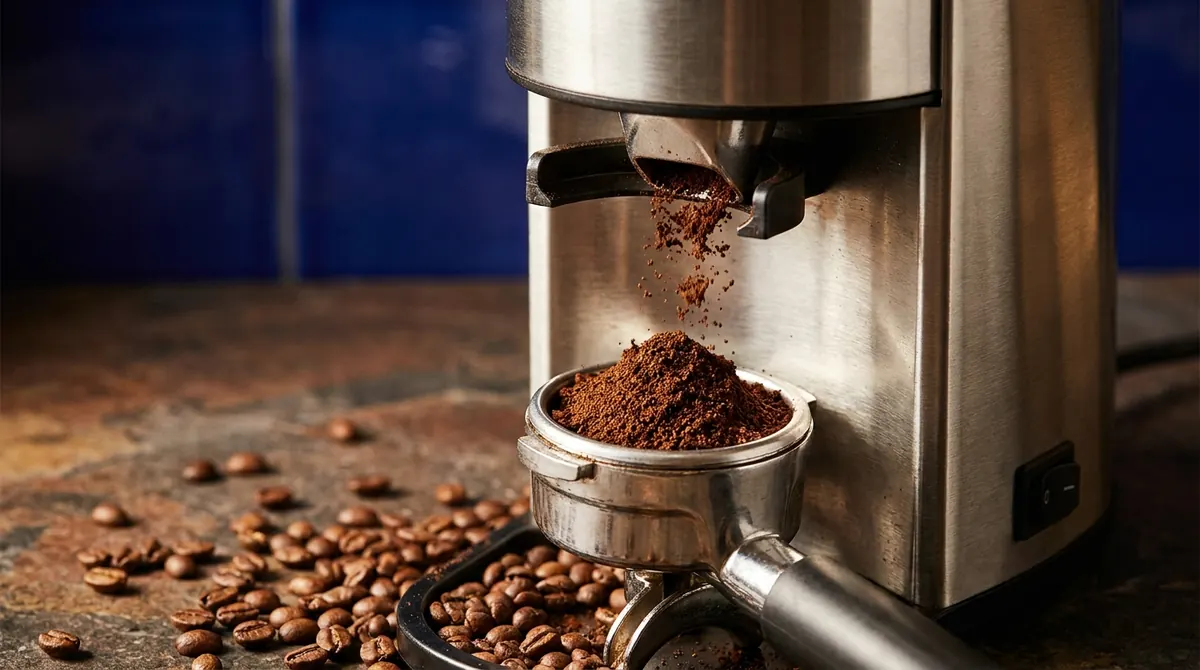
A single dose grinder lets you weigh one dose of beans, grind all of it and get nearly all of it back. The trick is picking one with low retention and a workflow you will actually enjoy.
By Daniel Russo. Updated .
The short answer
The Turin DF54 is the best value, with a 54mm flat burr and ultra-low retention at an entry price. The Niche Zero is the easiest to live with and the quietest, with conical burrs that lean toward body and sweetness. The Timemore Sculptor 064S gives the cleanest, most clarity-forward cup and the lowest temporary retention in one European test. The Eureka Mignon Single Dose Pro and the Mazzer Philos are the premium Italian options.
Price bands are rough street ranges and vary by region and retailer. Check the current price before you buy.
What single dosing means
Single dosing means weighing out only the beans for one shot, grinding them and collecting the same coffee in the portafilter. Put simply, it means filling the grinder with only enough for one espresso, rather than filling a hopper. The catch is that the coffee you collect should be the coffee you weighed. In a grinder that does not single dose well, some of the 18 grams you collect can be old grounds from the last shot. A grinder with a long, flat grind path can hold back many grams between shots.
Grinders that do this poorly usually have lots of retention or trouble with popcorning, when beans bounce around in the hopper because there is no pile of beans above to weigh them down. High-speed commercial grinders are the typical example. They are designed for cafes, where the hopper is always full and the grounds do not sit long.
The benefits at home:
Fresher coffee in the burr chamber, since no beans age in a hopper
Less of yesterday's coffee in today's cup
Easy switching between coffees, such as regular and decaf
Less waste when you dial in a new bag
What to look for
Factor
Why it matters
What to look for
Retention
Old grounds mix into your next dose
One retailer says the best keep it under 0.5 grams, and many use a bellows to blow out the last particles
Burr type
Shapes the taste in the cup
Flat burrs tend toward clarity, conical toward body and sweetness
Adjustment
Espresso needs small steps
A stepless dial or very fine steps
Noise
Early-morning grinding
A motor rated well under 80 dB
Static
Fines cling to the chute
An ionizer, a knocker, or a spray of water on beans
Dosing cup
Affects puck evenness
A cup that sits cleanly on the portafilter
Cleaning
Permanent retention builds up
Easy opening, ideally keeping your grind setting
A retailer who sells and services these says burr quality and the engineering of the burr set matter more than diameter alone, and that stepless adjustment is close to non-negotiable for espresso. For hopper-fed alternatives see our best espresso grinders and the budget grinder guide.
Turin DF54: the value pick
The DF54 is a compact flat burr grinder built around custom 54mm stainless steel burrs and a stepless dial with a metal indicator. Retailer specs list a robust aluminum body, a plasma generator in the exit chute to reduce static, and a hopper that holds 20 g, expandable to 50 g with the included bellows. One retailer reports retention below 0.1 gram even without the bellows. The body is 304 mm tall and 4.5 kg, and a 58mm dosing cup is included.
A Canadian retailer calls it the most compact in the DF range, and says it brings premium features such as flat burrs, retention control and stepless adjustment to an entry-level price. The trade is plain looks, and the weigh-every-time workflow of any single doser.
Niche Zero: the easy one
Niche's own spec sheet lists 63mm conical burrs, a stepless dial, a grind speed of about 1 gram per second, dose consistency of less than plus or minus 0.2 g based on independent data, and noise of 72 dB while grinding. It is 211 mm long, 311 mm tall (435 mm with the lid up), weighs 4.1 kg and has an aluminum body with oak trim. A 58mm grind cup is in the box, and a safety interlock stops the motor when the lid is open.
In a European retailer's test of ten single dose grinders between 500 and 1,000 euros, the Niche Zero was the quietest at 72.9 dB, and its conical burrs gave the widest particle peak and lowest fines content. The testers describe a velvety, body-forward cup that is forgiving at the dial and a good fit for chocolate and nut notes. Its temporary retention was 0.2 g, and simply closing the lid is often enough to keep it low.
Timemore Sculptor 064S: the clarity pick
Retailer specs list a 64mm stainless steel flat burr set, 36 stepless settings, 150 W, 800 to 1,200 RPM, a 4.1 kg body and a magnetic hopper cover and catch cup. Its hallmark is a rotary knocker that shakes statically charged fines out of the chute. It has no timer or scale, only an on/off switch, so you weigh beans by hand.
The same European test found the Timemore Sculptor 64S had the narrowest particle peak they had measured in that class, at 145 micrometers, and the lowest temporary retention at 0.1 g. They call it a clarity extremist, great with light, complex roasts. The downsides: the puck can be fragile and tricky to extract without careful distribution, and the included dosing cup has a thick rim that leaves a ring-shaped crater in the puck, so they suggest swapping it. The two Timemore models were the only grinders in that test that kept their grind setting after disassembly.
Eureka Mignon Single Dose Pro
Eureka's page for the Mignon Single Dose Pro lists a 65mm upper blind burr with no screw holes, diamond inside burrs, a patented stepless micrometric adjustment, a King Size dial with a revolution counter, an anti-retention system, a blow-up system and a 15 degree tilted body. Eureka states a dose consistency of plus or minus 0.15 g for espresso and plus or minus 0.05 g for filter. A seller describes a 45 g hopper with bellows and a larger dosing cup with a spout. Eureka also lists a 10-year warranty tied to its motors.
In the European test, it had a temporary retention of 0.7 g, the highest in the field of ten but still low in absolute terms, a noise of 81.1 dB and 11 seconds for 18 grams. It carries little static and gave a round, medium cup. See where it falls on retention before you pay the premium.
Mazzer Philos: the premium build
Mazzer calls the Philos a premium single dose flat burr grinder with 64mm burrs, a 12.5 kg body in stainless steel, brass and anodized aluminum, and a 400 W asynchronous motor. The adjustment ring sits at the back, so you can open the grinding chamber without tools and keep your grind setting. It switches between stepped mode, in steps as small as 6 microns, and a stepless mode. Two burr sets are offered: the I200D for clarity, and the I189D for body, from the old Mini lineage. A stainless dosing cup fits 58mm portafilters, held by magnets, and a dose-finisher cleans the chute.
A US specialty retailer says the Philos is the single dose grinder it recommends most, and gives retention as well under half a gram with the bellows technique. It was the most expensive pick here, in the $1,500 and up band.
Hand grinders
A hand grinder is single dose by nature. The 1Zpresso J-Ultra has 48mm conical burrs and a very fine external dial, and it costs about what a basic electric grinder does. It is silent and portable, but you crank it every morning and the hopper is small. Fine for one or two shots a day, tiring for a household that drinks milk drinks all morning.
Measured differences from one European test
Grinder
Noise (dB)
Time for 18 g
Temporary retention (g)
Permanent retention (g)
Timemore 64S
76.7
20.5 s
0.1
0.2
Niche Zero
72.9
13.5 s
0.2
0.7
Eureka SD Pro
81.1
11 s
0.7
0.1
These numbers come from a single retailer's test of ten grinders and should be read as a snapshot, not a guarantee. Temporary retention is the coffee from the previous grind that ends up in your current shot. Permanent retention is coffee that settles in spots and ages. The testers recommend opening and dry cleaning any grinder at least once a month if you drink dark, oily roasts. Two things drove the numbers: static, and slower, quieter motors that came with a more leisurely grind time.
Flat vs conical burrs
Burr type
Typical strengths
Flavor tendency
Best for
Flat
Clarity and separation
Distinct flavors, cleaner finish
Modern espresso, lighter roasts
Conical
Body, sweetness, forgiving workflow
Rounder texture
Traditional espresso, milk drinks
That is a tendency, not a rule. In the European test the conical Niche Zero came out body-forward and the flat Timemore clarity-forward, with the Eureka in the middle. Choose by the cup you like, then check that the grinder suits how you prep a puck.
A good single dose workflow
Weigh the beans on a scale, for example 18 g for a double basket.
If static is a problem, add a drop of water to the beans and stir, a method known as RDT.
Put the beans in the hopper and fit the bellows if the grinder has one.
Grind, then press the bellows or knock the chute to push out the last particles.
Distribute the grounds in the portafilter with a needle tool before tamping.
Brush the chute and burrs regularly and open the grinder for a full clean about once a month.
Beans age in the hopper, and more coffee is retained
A hopper grinder can still be excellent for a household that drinks the same medium roast every day. A single dose grinder pays off most if you switch coffees or care about light roasts. Neither replaces a good grinder paired with a good machine, which is why our under $2,000 guide counts the grinder in the budget.
Which one should you buy?
If you
Choose
Want the best value for espresso
Turin DF54
Want the quietest, easiest grinder
Niche Zero
Prefer a bright, clean light roast cup
Timemore Sculptor 064S
Want a compact Italian flat burr grinder
Eureka Mignon Single Dose Pro
Want a heavy premium build and burr options
Mazzer Philos
Drink one or two shots a day on a budget
1Zpresso J-Ultra
Questions people ask
What is a single dose grinder?
A grinder you fill with just one dose of beans, which it grinds completely. It is meant to have very little retention, so what comes out is what you weighed.
How much retention is acceptable?
One retailer says the best single dose grinders keep it under 0.5 grams. In one European test, the best figures were 0.1 to 0.3 g, and the worst was 0.7 g.
Are single dose grinders better than hopper grinders?
They are different. A single dose grinder keeps beans fresh and makes switching easy. A hopper grinder is more convenient if you drink one coffee daily.
What is RDT?
The Ross Droplet Technique. You add a small spray of water to the beans before grinding to cut static. Some retailers say certain grinders need it to keep fines from clinging.
Flat burrs or conical burrs for espresso?
Both make excellent espresso. Flat burrs tend toward clarity and conical toward body. Choose the cup you prefer and how much puck prep you want to do.
Do I need a bellows?
Not always. A retailer reports the DF54 retains under 0.1 gram even without one, but a bellows helps push out the last grounds on many grinders.