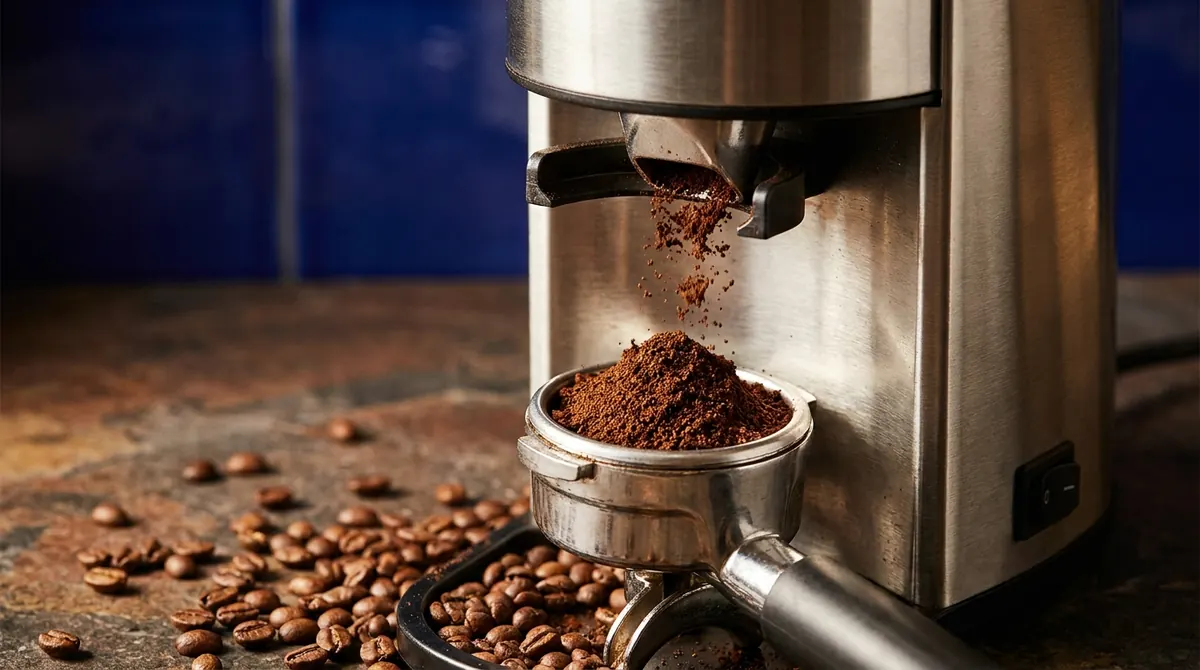
The best hand grinder for espresso: what really works
Espresso is the hardest job you can give a manual grinder. It needs the finest grind, the most cranking and the smallest adjustment steps, and many popular hand grinders simply cannot do it.
By Daniel Russo. Updated .
The short answer
The best hand grinder for espresso is the 1Zpresso J-Ultra: it is built for espresso, adjusts in tiny steps and grinds a 16 to 18 g dose in roughly 40 to 55 seconds. The 1Zpresso K-Ultra is the best if you also make pour over, the Mavo Phantox Pro is the pick for modern light-roast espresso, the MHW-3Bomber Blade R3 is the budget all-metal choice for medium-dark roasts, and the Q Air is the cheapest and lightest if you accept a longer grind. Skip filter-only grinders such as the 1Zpresso ZP6.
The J-Ultra is the espresso-focused model of the 1Zpresso line. Its adjustment is extremely fine (about 8 microns per click), the burrs and axle are tuned for espresso, and a 16 to 18 g dose takes roughly 40 to 55 seconds. Shots are described as thick, sweet and complex, closer to what a good electric grinder makes than most manual options.
Burrs
48mm conical
Settings
External dial, very fine steps
Dosing
Hand crank, single dose
Use
Espresso first
Why we like it
Espresso-grade grind for the price of a basic electric
The K-Ultra shares the J-Ultra's body and magnetic catch cup but uses a different burr set. It makes very good pour over and capable espresso at a setting around 2.4, so one grinder can serve a household that brews both ways.
Burrs
Steel conical (heptagonal-style)
Settings
External dial; espresso reported near setting 2.4
Dosing
Hand crank, magnetic catch cup
Use
Espresso and filter
Weight
Not listed
Why we like it
One of few hand grinders good for both espresso and pour over
Magnetic catch cup and foldable handle
Fast: roughly 40 to 50 seconds for a 16 to 18 g espresso dose
A 45 mm conical burr and 120 external settings in 16.7 micron steps make the Phantox Pro strong with light roasts, giving balanced shots without harshness. It can taste thin on medium to dark roasts, so match it to the beans you buy.
Burrs
45 mm conical, in-house
Settings
120 settings, 16.7 micron steps, external dial
Dosing
Hand crank, single dose
Use
Modern and light-roast espresso, pour over
Weight
614 g with handle
Why we like it
Handles light-roast espresso with balanced acidity
External adjustment, most brew methods inside one rotation
An all-metal body, external adjustment, a magnetic catch cup and sifting screens at a low price. It handles espresso in about 50 seconds for 16 g and is sweet and forgiving with medium and dark roasts.
Burrs
Conical steel burrs
Settings
60 clicks per turn, 16 micron steps, external dial
Dosing
Hand crank, magnetic catch cup, sifting screens
Use
Espresso (medium-dark roasts) and filter
Weight
Not listed
Why we like it
All-metal body with external adjustment at a low price
About 360 g, tiny, and fits inside an AeroPress plunger. It can grind for espresso, but the small handle makes a 16 g dose take roughly 60 to 70 seconds.
Burrs
38 mm heptagonal steel
Settings
Stepped dial with markings
Dosing
Hand crank, 16 to 19 g capacity
Use
Filter first, espresso with effort
Weight
About 360 g
Why we like it
Very light and small, fits inside an AeroPress plunger
Steel frame and good bearings under a plastic shell
Low price for the burr quality
Keep in mind
Espresso takes 60 to 70 seconds for 16 g
Small capacity and plastic catch cup that builds static
Widely used and well documented, but coarse click steps make espresso dial-in harder unless you add the Red Clix kit. It suits people who also brew filter and want a famous name.
Burrs
High-nitrogen steel conical, German-made
Settings
Click dial (finer steps with the Red Clix add-on)
Dosing
Hand crank, polymer catch cup
Use
Filter first, espresso possible
Weight
Not listed
Why we like it
Famous, widely documented recipes
Burrs suit both espresso and pour over
Built in Germany
Keep in mind
Click steps are coarse for dialing espresso without the Red Clix add-on
Espresso needs a much finer grind than filter coffee, and fine grinding takes more turns and more force. A grinder that handles pour over in 30 seconds can take over a minute for an espresso dose, and a few cannot reach espresso fineness at all. Two other things matter just as much:
Adjustment resolution. Espresso is sensitive to tiny changes. A change of one click can move a shot from 18 seconds to 35. Grinders with fine external steps (8 to 17 microns per click) are far easier to dial in than click wheels with coarse steps.
Burr size and sharpness. Large steel conical burrs cut fast and consistently. Small ceramic burrs are slower and less even.
For these reasons, some experts suggest an electric grinder for anyone who makes espresso every day. If you still prefer a hand grinder, pick one of the models above.
Hand grinders that cannot do espresso well
Model
Why it is a poor espresso choice
1Zpresso ZP6 Special
Built for filter coffee only; it cannot grind fine enough for espresso
Timemore Chestnut S5
Cannot grind fine enough for real espresso
Timemore C2s
Very slow for espresso, so not recommended; the C3 model is better for espresso
Hario Skerton and Mini Slim
Older ceramic-burr design, slow and uneven; skip for any use
Very cheap marketplace grinders
Many are low-quality copies; stick to established brands
Established hand grinder brands include 1Zpresso, MHW-3Bomber, Kingrinder, Timemore, Pietro, Orphan Espresso (Lido), Comandante, Kinu and Millab. Anything outside that group deserves extra caution.
How long it takes and how hard it is
Grinder
Espresso dose time
Effort note
1Zpresso J-Ultra
40 to 55 seconds for 16 to 18 g
Slim, light body and a comfortable handle
1Zpresso K-Ultra
40 to 50 seconds for 16 to 18 g
Very fast and ergonomic
MHW-3Bomber Blade R3
About 50 seconds for 16 g
Long handle gives leverage
Comandante C40
About 50 seconds for 20 g
Thick body, can be awkward in small hands
Millab M01
55 to 60 seconds for 16 g
Heavy, straight handle, a workout
1Zpresso Q Air
About 60 to 70 seconds for 16 g
Small handle, worth it for the weight and price
Times come from published reviews and vary with the beans, the setting and your grip. Light roasts are denser and take longer. A foldable or long handle and good bearings make a real difference to how the effort feels.
Adjustment: what the numbers mean
External dial. A numbered dial on top of the grinder lets you change the setting without opening it. This is the most convenient and the best for switching between espresso and filter.
Internal adjustment. A nut or ring under the burr. Cheaper, but you have to open the grinder to change the grind, so tracking settings is harder.
Micron per click. About 8 microns per click (J-Ultra) is finest and best for espresso. About 16 to 17 microns (Phantox Pro and R3 Blade) is still fine for espresso. Larger steps, such as the Comandante's, make espresso dial-in coarser unless you add an upgrade kit.
Stepless or stepped. Stepless dials allow any grind, stepped dials give repeatable settings you can write down.
Burrs: steel, shape and size
All hand grinders use conical burrs, apart from a small number of flat-burr outliers. Steel burrs are sharper and cut faster and more evenly than ceramic ones, and nearly every grinder above uses them. Burr shape changes taste:
Burr style
Typical taste
Examples
Heptagonal conical
Bright and clear, sometimes slightly acidic in espresso
1Zpresso K-Ultra, Comandante-style designs
Larger conical, in-house design
Balanced, more mid-notes and less acidity
Mavo Phantox Pro (45 mm)
Multi-phase Pineapple burr
Focused, precise, close to flat-burr clarity
Millab M01
Espresso-tuned conical
Thick, sweet, textured
1Zpresso J-Ultra
None of this makes one grinder better in every cup. Choose by the coffee you like: balanced and sweet for medium-dark roasts, clear and bright for light roasts.
Roast level and grinder pairing
Your coffee
Better fit
Reason
Traditional Italian-style, medium to dark
MHW-3Bomber Blade R3, J-Ultra
Sweet, blended, forgiving cups
Modern light-roast espresso
Mavo Phantox Pro, Millab M01
Clear, balanced acidity
Espresso and pour over at home
1Zpresso K-Ultra
Strong at both
Mostly travel
1Zpresso Q Air
Smallest and lightest
Capacity, catch cups and static
Most hand grinders hold 15 to 25 g of beans, which is enough for one to two espresso doses. The 1Zpresso Q Air holds 16 to 19 g depending on the beans. Check capacity against the dose you use. Catch cups matter too: magnetic cups (J-Ultra, K-Ultra, R3 Blade) are quicker to use than threaded ones. Plastic catch cups and fine grinds can build static. A drop of water on the beans before grinding, known as the Ross Droplet Technique (RDT), reduces static and clumping. A distribution tool and a scale complete the workflow.
Weigh a dose that fits your basket, for example 16 to 18 g for a standard double basket.
Start near the maker's suggested espresso setting. A number near 2.4 on the K-Ultra or between 1.0 and 1.5 on the Phantox Pro are published starting points.
Grind, level, tamp and pull the shot. A common target is roughly twice the dose in liquid weight in 25 to 30 seconds.
If the shot runs fast and tastes sour, move one step finer. If it runs slow and tastes bitter, move one step coarser.
Change one thing at a time and write the setting down.
Expect three or four shots to settle a new bag of beans.
Care and maintenance
Brush out the burr chamber regularly. Grinding itself clears most of the grounds, so heavy cleaning is rarely needed.
Disassemble and clean the burrs every few months, using the right tool. Some grinders need a hex key.
Do not wash burrs with water unless the maker says so, and dry everything completely.
Check that the handle nut, bearings and catch cup threads stay tight.
Recalibrate after reassembling, because the zero point may shift.
1Zpresso J-Ultra in detail
The J-Ultra is the maker's espresso model and sits in its espresso collection, while the K-Ultra is labeled all-purpose. Inside and out it is close to a K-Ultra, but the burrs and axle are changed so adjustment is finer, at about 8 microns per click. The body is slimmer and lighter than its predecessor, the foldable handle is less likely to be knocked over, and an improved burr coating keeps static and retention low so you get nearly the full dose out. The shots are thick, sweet and complex, and shots are more textured than the K-Ultra and the Comandante in a published comparison.
Strengths: the finest adjustment on this list, magnetic catch cup, comfortable speed.
Weaknesses: poor for pour over, and the 8 micron steps make it easy to get lost when moving between espresso and coarser settings.
Flavor lean: traditional espresso with body and texture more than modern clarity.
1Zpresso K-Ultra in detail
The K-Ultra is the flagship all-purpose model. It has an external dial that lets you move between espresso and pour over in seconds, for example about 2.4 for espresso and 6 to 7.5 for pour over. The magnetic catch cup removes threads, and the foldable handle keeps it stable between uses. It grinds a pour-over dose in roughly 23 to 28 seconds and an espresso dose in 40 to 50 seconds. The espresso is excellent but leans slightly acidic, which is typical of heptagonal burrs. It costs more than most mid-range models, and some owners report problems with the wooden handle knob.
Mavo Phantox Pro in detail
The Phantox Pro uses large 45 mm in-house conical burrs in an aluminum body that weighs about 614 g with the handle. Its 120 settings and 16.7 micron steps mean most methods sit inside one rotation of the dial, with espresso near the low end of the scale (published starting points are about 1.0 to 1.5). The flavor profile is balanced, with enhanced mid-notes and less acidity than heptagonal designs, and you can push the grind fine before astringency appears. It shines with modern lighter roasts and can give thin, hollow shots with medium to dark roasts. A hex key is needed to take it apart.
MHW-3Bomber Blade R3 in detail
The R3 Blade is a budget grinder with flagship features: an all-metal body, a 60-click external dial with 16 micron steps, a magnetic catch cup that uses more magnets than some pricier models, and five interchangeable sifting screens for fines removal. Espresso takes about 50 seconds for 16 g, and the long handle gives good leverage. It produces sweet, blended cups and is forgiving across roast levels, especially medium-dark. Sifting changes the flavor and is not always an improvement, so use it sparingly. Static builds up without a droplet of water. A newer R3 Pro drops the magnetic catch cup and the burr swap option, so look for the original model if those matter to you.
1Zpresso Q Air in detail
The Q Air is the cheapest 1Zpresso. The outer shell is plastic, but removing it reveals the same steel frame and bearing system as the Q2, and the 38 mm heptagonal burrs are proper steel. It weighs about 360 g, small enough to fit inside an AeroPress plunger for carry-on travel. Pour-over cup quality is higher than most grinders at this price, but espresso is work: the small handle and the 16 to 19 g capacity mean a 16 g dose takes about 60 to 70 seconds. The stepped dial has clear markings but is less convenient than an external dial. Use a droplet of water to fight static from the plastic catch cup.
Millab M01 in detail
The Millab M01 is Timemore's luxury brand. It weighs about 1.1 kg and is built almost entirely from aluminum and steel. The multi-phase Pineapple burr gives a grind distribution close to a flat burr in uniformity, and espresso is focused and precise, leaning modern rather than traditional. The external adjustment is a pleasure to use, but the straight handle and wide body make espresso a workout at 55 to 60 seconds per 16 g dose. It suits design-minded people who want a balanced, clean cup and do not mind the effort.
Comandante C40 Mk4 in detail
The C40 is one of the best-known hand grinders. Its high-nitrogen steel burrs are designed in Germany, the polymer catch cup replaced the old glass one on the Mk4, and its click recipes are widely shared online. Its drawback for espresso is the click adjustment, which is coarser than the external dials above; the Red Clix add-on adds finer steps. It is a bit slow (about 50 seconds for 20 g in one published test) and wide in the hand. Many cheaper models perform similarly, so you partly pay for the name and German manufacture.
Handles, bearings and ergonomics
Handle length: a longer handle gives more leverage, which matters most at espresso fineness. A short handle makes the same grind noticeably harder.
Bearings: premium models use double or triple ball bearings, so the shaft turns smoothly. Without bearings you spend extra energy.
Body width: wide bodies are harder to grip with small hands. The Q Air and the slim J-Ultra are friendlier than the Comandante or the Millab.
Foldable handle: helpful for storage and for stopping the grinder from being knocked over.
Non-slip surface: textured or ridged metal improves grip, especially with a heavy body.
Accessories that help
Accessory
What it does
Worth it?
Scale
Weighs the dose and the shot so results repeat
Yes, essential
Water spritzer
Applies a droplet to beans to cut static (RDT)
Yes, especially with plastic catch cups
Distribution tool
Breaks clumps and evens the grounds in the basket
Yes, for naked portafilters
Tamper that fits your basket
Compresses the puck evenly
Yes, if not included
Travel case
Protects the grinder in a bag
Handy for travel
Red Clix kit (Comandante)
Finer adjustment steps for espresso
Yes, if you buy the Comandante for espresso
Extra catch cup
Lets you grind the next dose while one is in use
Optional
Troubleshooting by symptom
Symptom
Likely cause
Try
Shot gushes out in under 15 seconds
Grind too coarse
Move one or two steps finer
Shot barely drips or chokes
Grind too fine or dose too high
Move coarser or reduce the dose
Shot tastes sour and thin
Under-extraction
Grind finer, check water temperature, lengthen the shot
Shot tastes bitter and dry
Over-extraction
Grind coarser or shorten the shot
Grounds clump and stick
Static
Add a droplet of water before grinding
Inconsistent shots
Uneven tamp or dose
Weigh the dose and level the grounds
Grinder feels rough or wobbly
Loose burr or worn parts
Check and retighten, replace worn parts
Settings drift
Locking mechanism loose
Retighten or recalibrate and note the zero point
Common mistakes
Buying a filter-only grinder and expecting it to make espresso.
Skipping a scale and dosing by scoop.
Changing the grind and the dose at once, which hides what fixed the shot.
Treating the price as a guide to espresso fit. The most expensive grinder is not always the best for a given roast.
Buying an unknown brand from a marketplace because it looks like a famous grinder.
Forgetting that a hand grinder needs a stable surface: brace the grinder with one hand and keep the catch cup level.
A realistic morning workflow
Weigh the beans into the grinder (16 to 18 g for a double).
Spritz a droplet of water onto the beans if static is a problem.
Grind in even strokes, with your thumb braced on the body.
Tip the grounds into the basket and level them with a distribution tool.
Tamp evenly and pull the shot, timing it from the first press of the button.
Rinse the portafilter and brush any grounds from the grinder.
The whole routine adds about a minute over a push-button electric grinder, and you can use that minute to heat the milk. See our milk steaming guide for the next step.
Older popular models and why they slipped
Model
Where it stands now
1Zpresso J (original)
Once a value leader; newer grinders offer external adjustment and a magnetic catch cup as standard, and the R3 Blade matches it for less
1Zpresso Q2
Superseded for budget and travel by the Q Air
Kingrinder P2
Similar cup quality to the Q Air but with rougher bearings and a more fragile feel
Kinu M47 Phoenix
Excellent burrs, but a cumbersome adjustment and a flimsy plastic catch cup
Lido 3
Over 1 kg, so impractical for travel, with a locking-ring adjustment that is awkward by current standards
Hario Skerton Pro and Mini Slim
Old ceramic-burr designs that modern steel-burr grinders have left behind
Older models can still be good used or on sale, but compare them to the current alternatives before you pay full price.
Five questions to pick your grinder
Is espresso your main drink? If yes, choose the J-Ultra. If you also brew filter, choose the K-Ultra.
What roast do you buy? Light roasts favor the Phantox Pro or Millab, medium-dark favors the R3 Blade or J-Ultra.
Will it travel? If so, the Q Air is lightest. Anything above 600 g is a deliberate carry.
How big are your hands? Slim bodies and long handles are easier with smaller hands.
What is your budget? Hand grinders cost less for the burr quality than electric ones, but espresso-capable models are not the cheapest.
Buying checklist
Confirm that the grinder is rated for espresso by its maker, not only for filter or AeroPress.
Check for an external adjustment dial and a fine step size.
Prefer steel burrs and ball bearings.
Check capacity against your dose.
Choose an established brand, because many knock-offs exist.
Buy from a seller that covers warranty, parts and replacement handles or catch cups.
Hand grinder vs a cheap electric grinder
For the same budget, a hand grinder usually has better burrs than an entry-level electric grinder, because you are not paying for a motor and housing. A low-priced electric grinder is easier to use, but many struggle to make fine, even espresso grinds. The best compromise for people who want push-button speed is a dedicated espresso electric from our budget grinder guide. If you are willing to crank, a hand grinder gives better value.
Pour-over times for the same grinders
Grinder
Pour-over dose time
Note
1Zpresso K-Ultra
23 to 28 seconds for 15 g
Among the fastest hand grinders
Mavo Phantox Pro
25 to 30 seconds for 15 g
Large burrs grind quickly
MHW-3Bomber Blade R3
About 30 seconds for 15 g
Good all-rounder
Millab M01
About 35 seconds for 20 g
Between very fast and traditional
1Zpresso Q Air
About 35 seconds for 15 g
Meditative rhythm
Comandante C40
About 50 seconds for 20 g
Slower than rivals
Filter grinding is much easier than espresso grinding, so if you brew both, a model that is quick at pour over and still handles espresso, like the K-Ultra, saves effort overall.
Who should skip a hand grinder
People who make several espressos a day. Cranking adds up quickly.
Anyone with limited hand or wrist strength. Fine grinding takes force.
Households that want quick milk drinks in a rush. The extra minute matters at the busiest time.
People who like switching between many coffees daily. Constantly re-dialing a fine espresso grind is tedious by hand.
For them, an electric espresso grinder pays back in time. For everyone else, a good hand grinder is one of the best-value upgrades you can make for espresso.
Storing beans and grinding fresh
A hand grinder works best when you grind only what you need for each shot, because freshly ground coffee loses aroma quickly. Store whole beans in an airtight container away from heat and light, and weigh each dose before grinding. Because hand grinders retain almost nothing, the coffee you weigh in is the coffee you get out, so each shot tastes as fresh as the beans allow. That is one of the quiet reasons people who switch from a hopper grinder notice a cleaner cup even before they optimize anything else.
Setting a budget
Espresso-capable hand grinders span a wide range of prices. Think in tiers: a budget tier for models like the Q Air and R3 Blade, a mid tier for the J-Ultra and Phantox Pro, and a premium tier for the K-Ultra, Millab and Comandante. If espresso is your only use, the mid tier delivers most of the gain. Spend more only if you value the extras: dual use for filter, a particular burr flavor or a luxury build.
Who should buy which grinder
If you
Buy
Why
Want the best espresso from a hand grinder
1Zpresso J-Ultra
Built for espresso with the finest steps
Brew both espresso and filter
1Zpresso K-Ultra
One tool for both
Drink light-roast espresso
Mavo Phantox Pro
Balanced acidity at fine settings
Drink medium-dark roasts on a budget
MHW-3Bomber Blade R3
Forgiving, metal build
Travel light
1Zpresso Q Air
Tiny and cheap
Want a luxury object
Millab M01
Fine build, focused cup
Want a famous name
Comandante C40 Mk4
Popular, with recipe sharing, add Red Clix for espresso
Questions people ask
What is the best hand grinder for espresso?
The 1Zpresso J-Ultra is the best choice for espresso: it adjusts in very small steps and produces thick, sweet shots. The K-Ultra is the better choice if you also brew filter coffee.
Can a hand grinder make espresso?
Yes, but only models with a fine enough grind range and precise adjustment. Several popular models, such as the ZP6, cannot grind fine enough.
How long does it take to grind espresso by hand?
About 40 to 70 seconds for a 16 to 20 g dose, depending on the grinder, the beans and your grip.
Is a hand grinder better than an electric one?
A hand grinder gives excellent burr quality for the money, low retention and easy travel. An electric grinder saves effort. For daily espresso, many people prefer electric.
Is the 1Zpresso J-Ultra better than the K-Ultra for espresso?
Yes for espresso only, because it has an axle and burrs designed for finer adjustment. The K-Ultra is the better all-rounder.
Which hand grinder is best for light roasts?
The Mavo Phantox Pro is reported to give balanced light-roast espresso without harshness. The Millab M01 is also strong for modern espresso.
What is the cheapest hand grinder that can do espresso?
The 1Zpresso Q Air is a low-priced option that can grind for espresso, though it takes about 60 to 70 seconds for a 16 g dose.
What is RDT and do I need it?
RDT is the Ross Droplet Technique: a small spritz of water on the beans before grinding to reduce static. It is helpful on plastic catch cups and fine grinds.
Do hand grinders need cleaning?
Lightly. Brush out the chamber often and do a full disassembly every few months.
Can I use my hand grinder for French press too?
Yes. Most espresso-capable hand grinders also reach coarse settings, but moving from espresso to coarse can take several turns of the dial.
Is it worth grinding espresso by hand every day?
It depends on how you feel about the effort. A fine espresso grind takes 40 to 70 seconds of cranking. If that sounds tiring, an electric grinder may suit you better.
Are expensive hand grinders worth it?
Up to a point. Steel burrs, external adjustment and bearings make a big difference, but beyond the mid-range the gains are smaller and often a matter of taste and finish.
How do I know a hand grinder can grind fine enough for espresso?
Check the maker's description. Espresso-capable models are marketed for it and list a fine adjustment range. Filter-only models, such as the ZP6, say so.
What is the difference between conical and flat burrs?
Almost all hand grinders use conical burrs. Flat burrs, found on a few models, are often credited with more flavor clarity but are less common in manual grinders.
Can I use a hand grinder for single dosing?
Yes. Hand grinders are built for single doses and retain very little coffee.
What dose should I grind for a double shot?
Most standard double baskets take 16 to 18 g. Check the basket's rated dose.
Should I buy a hand grinder if I already own a machine with a built-in grinder?
Only if the built-in grinder limits you. Built-in grinders often have a narrow espresso range, so a separate hand grinder can widen your options, though you then use the machine without its grinder.
Does grind consistency matter more than speed?
For espresso, yes. A slower grinder that produces even particles gives better shots than a fast one that does not, though the best models do both.