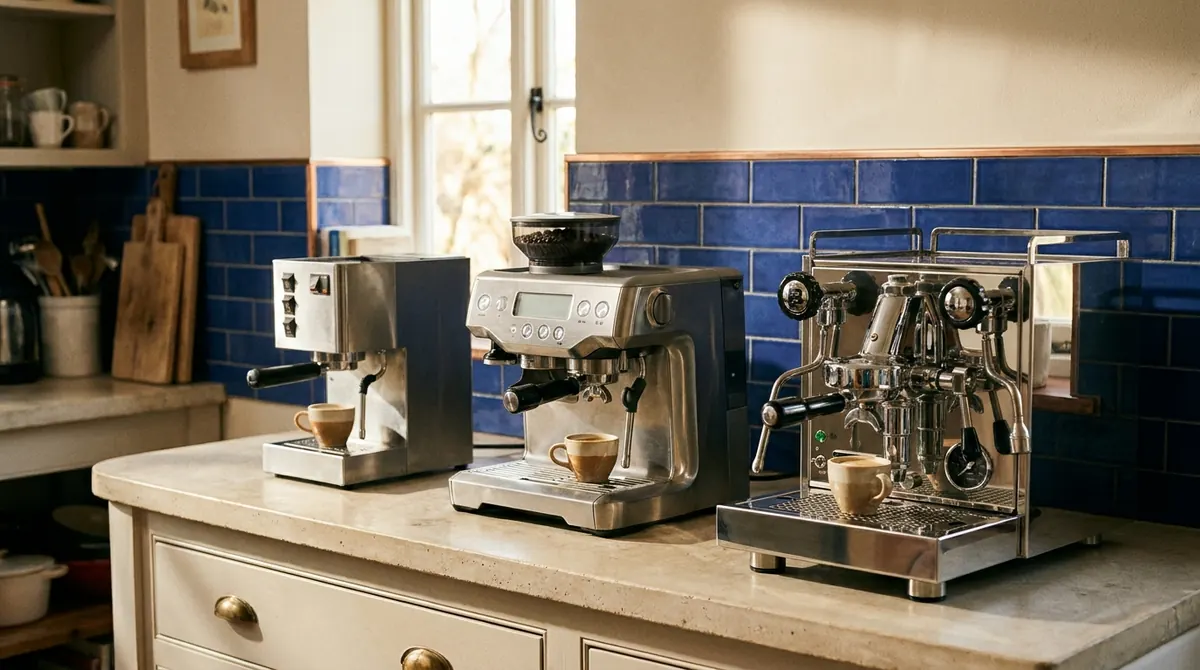
The milk system decides how much work your latte is. Pick between a steam wand you control, an automatic wand that does the stretching for you, or a one-touch carafe.
By Daniel Russo. Updated .
The short answer
For most people the Breville Bambino Plus is the best mix of control and convenience: an automatic steam wand with three temperatures and three texture levels, or a manual wand when you want one. If you want milk drinks at the touch of a button, a Philips 3200 LatteGo or a De'Longhi with a LatteCrema carafe is the easier route, at the cost of milk that is warm rather than hot. If you want latte art and the most control, a commercial-style wand on a Gaggia Classic is the classic choice.
A container plugs into the machine, which draws up and froths the milk
Speed and hands-free drinks
Warmer, stiffer foam and more parts to clean
Panarello sleeve
A plastic sleeve over the wand pulls in a fixed amount of air
Simple, airy foam for cappuccinos
Cannot fine-tune the texture
A manual wand works in two phases. First you hold the tip just under the surface to let in air, which bakers call stretching. Then you sink it a little deeper and angle the pitcher to spin the milk into a vortex, which breaks big bubbles into glossy microfoam. Retailers who sell both types say that manual wands give the best quality foam for latte art, while carafes produce a stiffer, more layered foam. For the how-to, see how to steam milk.
Why the heating system matters for milk
Espresso brews at about 200 degrees F while steam needs about 260 degrees F, so the machine has to jump between temperatures. One retailer sorts the heating systems this way:
Heating system
Brew to steam switch
Notes
Thermoblock or ThermoJet
Seconds
Heats water on demand; fast mornings
Single boiler
45 seconds to two minutes
You wait for the boiler to climb to steam temperature
Heat exchanger or dual boiler
No wait
Brew and steam at the same time; costs more
Real examples back this up. A Gaggia Classic Pro switches from brewing to steaming in about 30 seconds in one review, while a Rancilio Silvia takes about 90 seconds. For more, read Gaggia Classic vs Rancilio Silvia. If you want to brew and steam together, see the dual boiler guide.
Breville Bambino Plus: the automatic wand
Breville's page for the Bambino Plus describes a powerful hands-free automatic steam wand that makes microfoam milk, with three adjustable milk temperatures and three levels of texture, or hands-on manual texturing like a barista. The ThermoJet heating system is ready in 3 seconds. A 54mm portafilter takes an 18 g dose, and espresso gets a low-pressure pre-infusion followed by 9 bar extraction from a 15 bar pump. The machine measures 11.9 by 7.4 by 14.3 inches and comes with a 16 oz stainless steel jug and single and dual wall baskets.
One trade review explains how the auto wand works: the milk jug sits on a small sensor that reads the milk temperature, the wand stops when it reaches your setting, and after you lift out the jug and rest the wand the machine purges it into the drip tray. The same review measured about 53 dB while brewing and 51 dB while frothing and says you can choose between eight colors in the US. A retailer notes the low-profile portafilter clears cups up to 5 inches tall, and the tank holds 2 L. The Bambino Plus sits in the $300 to $500 band. See the best espresso machines under $500.
Breville Barista Touch: grinder and wand together
If you want the grinder in the same body, the Barista Touch adds a built-in conical burr grinder with 30 settings, ThermoJet heating and a touchscreen with latte, flat white and other recipes, plus an automatic steam wand that textures milk for you. A retailer states it uses the same auto-frothing, temperature-sensing steam wand as the Bambino Plus. It costs more, and its 54mm basket is smaller than the 58mm on the Oracle Jet. Read the Barista Touch review.
Gaggia Classic: a commercial manual wand
The Gaggia Classic Pro and its Evo Pro update use a commercial steam wand in place of the old Panarello sleeve. A retailer says it was replaced alongside commercial-grade rocker switches. Reviewers say the steam is strong enough for silky microfoam, though one found the wand flimsy and not fully rotating, which makes steaming a little awkward at first. The boiler is small, so it suits one or two milk drinks at a time, and switching from brewing to steaming takes about 30 seconds. Because it has no built-in grinder, you also need to buy one. See our Gaggia Classic review.
Philips 3200 LatteGo: the easiest one-touch milk
Philips' spec sheet for the EP3241 describes a LatteGo milk system with two parts and no tubes, which it says can be cleaned in as little as 15 seconds under the tap or in the dishwasher. Its cyclonic frothing sends a stream of microbubbles at 394 meters per second, according to Philips. The milk carafe holds 0.26 L, the water tank 1.8 L and the bean hopper 275 g. The ceramic grinder has 12 steps, the pump is rated at 15 bar and the drinks are espresso, coffee, cappuccino, latte macchiato and americano. The drip tray and LatteGo are dishwasher safe, and it has a 2-year guarantee.
Philips also lists a Quick Clean option that flushes hot water through the system. Its guidance: after each use, separate the two parts and rinse under lukewarm water or put them in the dishwasher. Retailers put this near the top for ease of cleaning, but note the foam cannot match a professional steam wand. See the Philips review.
De'Longhi LatteCrema: carafe that goes in the fridge
De'Longhi's LatteCrema systems pair a milk carafe with the machine. On the Dinamica Plus the thermal carafe can be stored in the refrigerator, and the manual wants milk at about 5 degrees C, skimmed or partially skimmed for a denser froth. A dial sets the froth level and a clean position flushes the system. The manual calls for cleaning the milk container every two days. The Rivelia includes a LatteCrema Hot system with auto-clean, with an optional cold upgrade for six cold milk recipes. One reviewer says the Dinamica's milk is nicely textured and drinkable, and another says automatic systems in general give warm, not hot, milk. For the full De'Longhi line see the best De'Longhi espresso machines.
Other options
Ninja Luxe Café Premier. A combo machine with a built-in grinder, weight-based dosing and a Dual Froth System with presets for hands-free froth. It makes espresso, drip coffee and cold brew, with less shot control than a classic semi-automatic. See Breville vs Ninja.
Nespresso Lattissima One. One-touch lattes and cappuccinos from pods with a built-in milk jug that washes easily. The jug makes a single serving. See the best Nespresso machines.
Casabrews CM5418. A very low-priced pump machine with a manual steam wand and a front pressure gauge. It uses pressurized baskets only, and has a lighter build. See the best cheap espresso machines.
Bambino vs Bambino Plus
Factor
Bambino
Bambino Plus
Price band
Under $400
$400 to $500
Milk
Manual steam wand
Automatic wand with sensor, or manual
Cup clearance
4 inches
5 inches
Water reservoir
48 oz
64 oz
Portafilter
54mm
54mm
Warranty
1 year
2 years
The table comes from one retailer's spec comparison. If you are happy to texture milk by hand, the standard Bambino costs noticeably less. If you want a sensor to shut the wand off at your chosen temperature and a larger tank, the Plus is the one to get.
Automatic milk on a bean-to-cup Breville
Breville's page for the Oracle Jet describes Auto MilQ, an automatic wand that textures milk with settings optimized for dairy, soy, almond and oat. You can adjust milk temperature from 104 to 167 degrees F and choose from eight texture levels, and Auto Queue starts the milk automatically when the espresso finishes. It also has a touchscreen with cafe favorites, a built-in grinder with 45 settings and automatic dose and tamp, so it is the closest thing to a hands-free semi-automatic. It sits at the top of the Breville range at $1,500 and up. Read the Oracle Jet review.
What the Dinamica Plus dial does
De'Longhi's Dinamica Plus puts a froth dial on the milk container lid. Per its manual, turn it to no froth for hot milk and caffelatte, minimum froth for latte macchiato and flat white, and maximum froth for cappuccino, espresso macchiato and frothed hot milk. After the last milk drink, you turn it to CLEAN with a cup under the spout, and then wipe the connection nozzle with a sponge. The manual says to leave the milk container in the machine for this step, and to keep the container in the fridge between drinks, because the warmer the milk, the poorer the froth.
How loud and how fast
Noise and speed are part of the morning routine. One trade review measured the Bambino Plus at about 53 dB while brewing and 51 dB while steaming, and reports a heat-up of three seconds. Thermoblock and ThermoJet machines start quickly because they heat water on demand. A single-boiler machine like the Gaggia Classic needs minutes to warm up and then 30 seconds to switch to steam. De'Longhi's Rivelia and Dinamica Plus run an automatic preheat and rinse on every start-up, so allow a moment before the first drink.
Bands are rough street prices from this site, and the Philips and De'Longhi machines come with grinders while the semi-automatics do not. If you are choosing between a semi-automatic and a bean-to-cup, read semi-automatic vs automatic.
Quick technique for a manual wand
Fill a cold pitcher part way with cold milk, because the milk will grow as it takes in air. De'Longhi's manual says the liquid doubles or triples in volume.
Open the steam valve for a second to purge water from the wand.
Hold the tip just under the surface to let in air for a few seconds, then lower it a little and angle the pitcher to make a whirlpool.
Stop at around 150 degrees F, before the milk tastes scorched.
Stop the steam before you pull the pitcher away. De'Longhi warns about splashes of boiling milk.
Wipe the wand, purge it again, and pour.
Our full guide is how to steam milk. If you have never steamed milk before, expect the first few pitchers to be imperfect, and give yourself a week of daily practice before you judge the machine. A carafe or an automatic wand skips that learning curve, which is the main reason to buy one.
Which milk system is right for you
If you
Choose
Want microfoam and latte art
A commercial steam wand (Gaggia Classic, or a Breville manual wand)
Lift the wand out and let it purge into the drip tray
Empty the drip tray after each use
Philips LatteGo
Separate the two parts, rinse or use Quick Clean
Dishwasher
De'Longhi carafe
Run the CLEAN position and wipe the nozzle
Take apart the container every two days
A reviewer of the Bambino Plus notes that an espresso machine needs a bit more cleaning than a pod machine, but that the automatic purge makes it easy. Milk travels through plastic channels in a carafe system, so you need to run the cleaning cycles and wash parts to avoid sour milk build-up.
Which milk to use
The froth you get depends on the milk. De'Longhi's manual says the quality varies with temperature, type, brand and ingredients, and recommends milk straight from the fridge at about 5 degrees C. For a denser, more even froth on the Dinamica it asks for skimmed or partially skimmed milk. The Rivelia manual marks whole, semi-skimmed, soy, almond and oat milks as suitable. Whole milk steams easily, and barista versions of plant milks work well. For recipes see how to make a latte and how to froth milk without a frother.
Tiny boilers for large households. If you make four lattes in a row, a small single boiler will slow you down.
Carafes you will not clean. If you will not disassemble the carafe, choose the tube-free LatteGo or a manual wand.
Expecting latte art from a carafe. Automatic foam is stiffer and layered, not microfoam.
Questions people ask
What is the best espresso machine with a milk frother?
For most people, the Breville Bambino Plus. It has an automatic steam wand with three temperatures and three texture levels and can also be used manually. For one-touch convenience, choose a Philips 3200 LatteGo or a De'Longhi with a LatteCrema carafe.
Is an automatic frother as good as a steam wand?
Not for latte art. Retailers say automatic systems make stiffer, layered foam and warmer milk than a manual wand, but they are faster and need no technique.
Which is easiest to clean, a carafe or a wand?
The Philips LatteGo has two parts and no tubes, and Philips says it rinses in about 15 seconds or goes in the dishwasher. A manual wand is a wipe and a purge.
Can I use plant milk?
Usually yes. The Rivelia manual lists soy, almond and oat milks as suitable, and Breville says the Oracle Jet offers settings for dairy, soy, almond and oat. Barista versions froth best.
Do espresso machines with frothers need a grinder?
Most semi-automatic machines do not include one, so budget for it. Combo machines like the Barista Touch and Ninja Luxe Café, and super-automatics, have grinders built in.
How long does it take to switch from brewing to steaming?
On a ThermoJet machine, seconds. On a single boiler, 30 seconds to two minutes, such as about 30 seconds on a Gaggia Classic Pro and about 90 seconds on a Rancilio Silvia.