Home › Guides › 15 bar vs 20 bar
15 bar vs 20 bar espresso machines: does it matter?
No. The 15 or 20 on the box is the most the pump can push with nothing flowing. Espresso is brewed at about 9 bar.
By Daniel Russo. Updated .
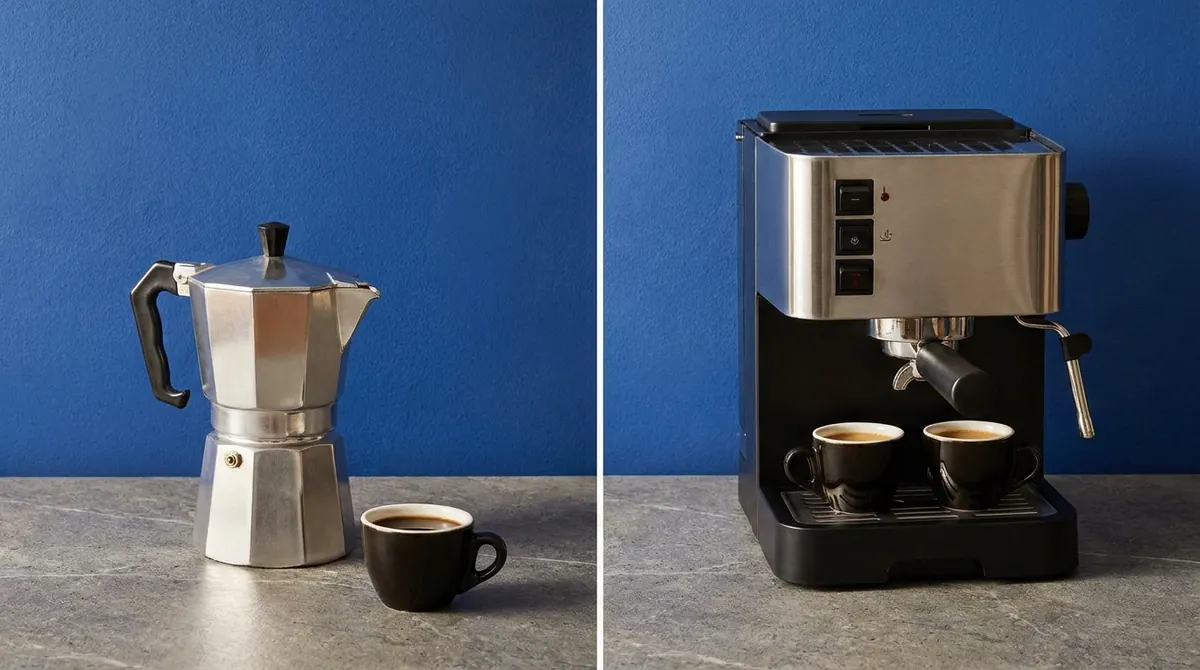
A 15 bar machine is not meaningfully better or worse than a 20 bar machine. Both numbers are the pump maximum with the outlet blocked, and both are meant to brew at about 9 bar at the coffee. Choose by temperature stability, basket type, grinder, steam wand and whether the machine has an over-pressure valve, not by the bar number.
What the number actually means
The bar rating is the highest pressure a pump can make when it is fully blocked and no water is moving. It is like a car speedometer that goes to 160 when you never drive that fast. It is a marketing number more than a performance number.
Pressure builds only when something pushes back, and in an espresso machine that is the coffee puck. Put your thumb over a garden hose: the water does not get stronger, but the more you restrict the outlet, the higher the pressure rises. Vibration pumps, which are common in home machines, also lose pressure as more water flows, so the number on the box happens only at zero flow.
| Term | What it means |
|---|---|
| Bar | A unit of pressure, about the air pressure at sea level. 9 bar is roughly 130 psi, about four times the pressure in a car tire. |
| Pump pressure rating (15, 19, 20 bar) | The maximum the pump can produce with the outlet blocked. |
| Brew pressure (about 9 bar) | The pressure at the puck during extraction. This is the one that matters. |
| OPV (over-pressure valve) | A valve that sets a ceiling below what the pump can do and sends the extra water back to the tank. |
| Pre-infusion | A gentle, low-pressure start to the shot before the pressure ramps up. |
Why 9 bar
At about 9 bar, water works through a tightly packed, finely ground puck in about 25 to 30 seconds. That is enough force to pull the oils and solids that make espresso syrupy and crema-topped without crushing the puck or forcing channels through it.
Nine bar is the industry standard that came with pump machines in the 1960s. Earlier spring-lever machines peaked at roughly 9 to 10 bar and then declined as the spring relaxed. It is a benchmark, not a law, and some modern recipes use lower pressure at points in the shot. For home buyers, 9 bar is the number to know.
Does a 20 bar machine make better espresso?
No, and a 15 bar machine does not either. Extra pump headroom can help a small home machine reach brew pressure steadily, and it can be more forgiving of an imperfect grind or tamp. It does not mean the coffee is extracted at 15 or 20 bar.
Actually brewing at 15 to 20 bar at the puck would be a problem. The puck compacts, resistance spikes and water forces channels through weak spots, so the shot comes out uneven and often both bitter and sour. More pressure does not mean more extraction.
| Question | 15 bar | 20 bar |
|---|---|---|
| Brews at about 9 bar at the puck? | Yes, when regulated | Yes, when regulated |
| Better espresso? | No difference by itself | No difference by itself |
| More forgiving of a poor grind or tamp? | Some headroom | More headroom, which beginners may notice |
| What decides shot quality? | Temperature stability, grinder, basket, technique | Temperature stability, grinder, basket, technique |
The OPV and the gauge
The real control on brew pressure is the over-pressure valve. The pump can push harder, and the OPV decides how hard it is allowed to. When the pump reaches the set point, the valve sends the extra water back to the tank. Many higher-end machines have an adjustable OPV, so you can set the pressure closer to 9 bar.
A pressure gauge shows brewing pressure live, which helps you diagnose puck prep. A high reading suggests the grind is too fine or the tamp too tight; a low reading suggests a coarse grind or light tamp. Many gauges measure at the pump rather than at the puck, so they usually read a little high. On heat exchanger and dual boiler machines, a second needle usually shows steam boiler pressure, not brew pressure. The Breville Dual Boiler has an over pressure valve and a gauge, and the Profitec Pro 600 lists a 15 bar maximum pump with adjustable brew pressure.
What to check instead of bar
- Basket type. Cheap 15 and 20 bar machines often come with pressurized baskets that fake crema. They are forgiving but cap shot quality. Machines with standard baskets reward good grinding.
- Temperature stability. A machine that holds temperature shot after shot beats one with a bigger number on the box. See the dual boiler guide for machines built around it.
- Pre-infusion. A gentle ramp is more useful than raw pressure. The Breville Bambino Plus lists a 15 bar pump with low-pressure pre-infusion and a steady ramp to 9 bar.
- Steam wand and milk. If you drink lattes, test the steam, not the bar rating.
- A real grinder. The grinder matters more than pressure. See the best espresso grinders.
| Machine | Portafilter | Heating | Price band | Price |
|---|---|---|---|---|
| Breville Bambino Plus | 54mm | ThermoJet, about 3 seconds | $300 to $500 | Check price |
| Gevi 20 Bar Espresso Machine | 51mm | Thermoblock | Under $200 | Check price |
| Profitec Pro 600 | 58mm E61 | Dual boiler with PID | $2,000 to $3,000 | Check price |
The Gevi lists 20 bar in its name, the Bambino Plus and the Profitec Pro 600 pump to 15 bar, and all three aim for about 9 bar in the cup. Their differences are in the heating, the basket and the milk system.
How to read a spec sheet
| If the listing says | It probably means | What to look for next |
|---|---|---|
| 15 bar pump | Maximum pump rating | Is there an OPV or a gauge? Is the basket pressurized? |
| 19 or 20 bar pump | Maximum pump rating | Same questions; do not treat the number as a plus. |
| 9 bar extraction | Regulated brew pressure | This is the useful claim. Ask how it is regulated. |
| Pressure gauge | A live reading, often at the pump | Use it to diagnose grind and tamp, not as lab data. |
| Low-pressure pre-infusion | A soft start before ramping up | Helpful for even extraction, especially with lighter roasts. |
Questions people ask
Is 15 bar enough for espresso?
Yes, with room to spare. Espresso needs about 9 bar at the puck, and a 15 bar pump has plenty in reserve.
Is a 20 bar espresso machine better than a 15 bar?
No. Both numbers are the pump maximum with the outlet blocked, and both are designed to brew near 9 bar. Compare temperature stability, baskets and grinder compatibility.
Can too much pressure ruin espresso?
Yes. Too much pressure compacts the puck and pushes water through weak spots, which causes channeling and harsh, uneven shots. An over-pressure valve is there to prevent it.
Why does my gauge read above 9 bar?
Usually the grind is too fine or the dose too high. Many gauges also measure before the water reaches the puck, so they can read a little high. A coarser grind brings the reading down.
Do I need a pressure gauge?
No, but it is a useful dialing-in tool. Machines without one, like the Breville Bambino Plus, can still make excellent espresso.
Sources
Read next
- Best under $300Small budgets, real espresso.
- Best cheapAffordable espresso machines that are worth it.
- Best semi-automaticMachines that give you control over every shot.
- Best espresso grindersGrinders that can actually grind fine enough for espresso.
- Use a De'Longhi espresso machineStep-by-step use for De'Longhi pump machines, La Specialista and Magnifica bean-to-cup models.
- Make a cappuccinoThe ratio, the milk, the steps and the fixes, with and without an espresso machine.